
The Executive Guide to Commercial Concrete Parking Lot Contracting
Your commercial parking lot isn't just a surface for vehicles; it's a high-stakes structural asset that defines your property's value and safety. Most owners treat paving as a simple commodity, only to face the frustration of premature cracking or the legal stress of non-compliant ADA slopes. It's a costly mistake that disrupts business and drains capital. Partnering with a specialized commercial concrete parking lot contractor ensures your infrastructure is built for permanence rather than temporary convenience.
This guide empowers you to master the engineering standards and vetting protocols required to secure a high-performance lot. You'll learn how to navigate complex drainage regulations and 2026 ADA requirements while maximizing your long-term ROI. We will break down the transition from initial site preparation to a finished, 30-year asset, providing a clear roadmap for seamless project management. From understanding compressive strength requirements to minimizing operational downtime, this is your executive blueprint for structural excellence.
Table of Contents
Beyond Paving: The Strategic Value of Concrete Parking Infrastructure
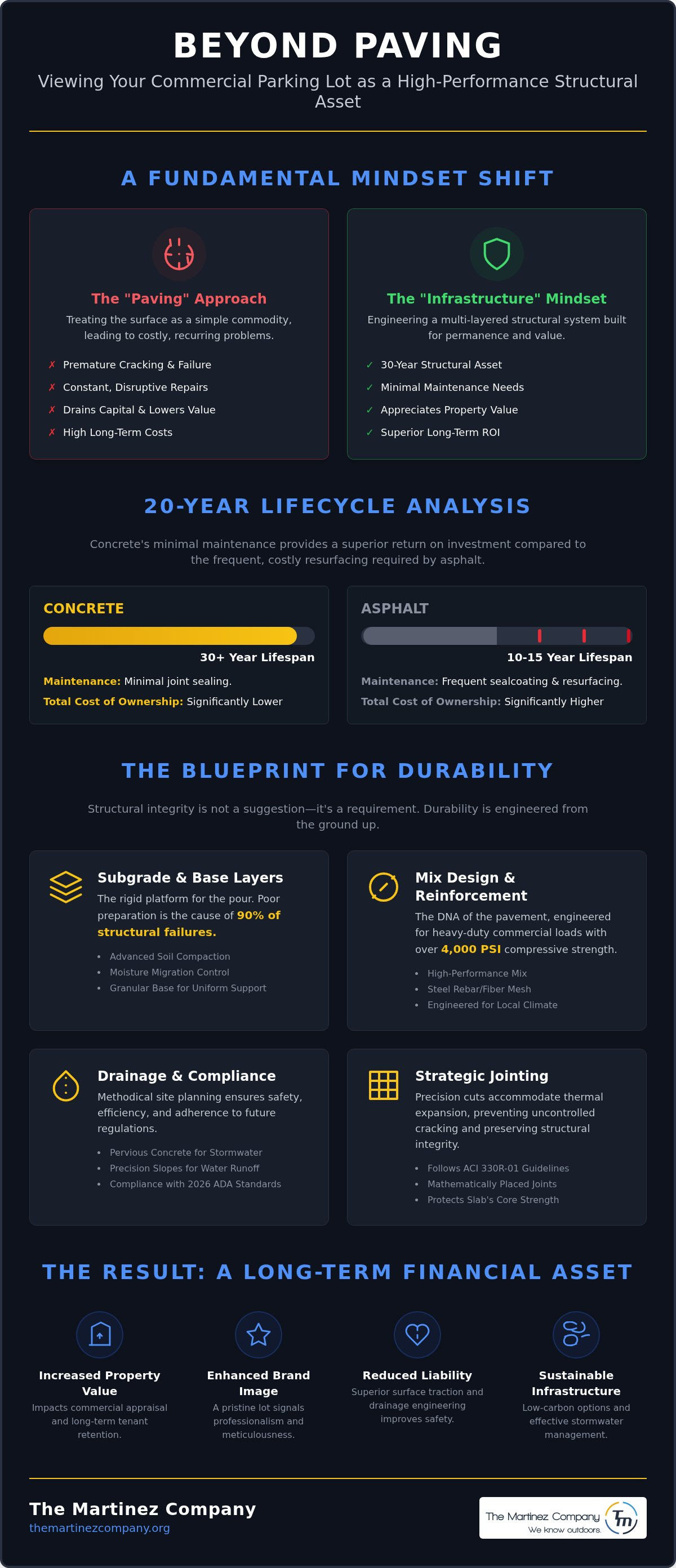
Commercial parking infrastructure is frequently misunderstood as a mere aesthetic choice. In reality, it is a sophisticated, multi-layered structural system engineered to withstand thousands of pounds of rolling vehicular loads. While asphalt often serves as a temporary fix requiring constant resurfacing and sealcoating, a professional commercial concrete parking lot contractor delivers a foundation of permanence. This shift in mindset from "paving" to "infrastructure" is what separates high-value commercial assets from deteriorating properties. High-quality concrete doesn't just sit on the ground; it anchors the property's financial future.
The 2026 construction landscape demands more than just strength. Modern developers are increasingly prioritizing sustainable infrastructure and low-carbon cement options to meet evolving environmental benchmarks. Utilizing specialized materials like Pervious Concrete allows for superior stormwater management, effectively turning a simple parking area into a functional part of the site’s drainage ecosystem. This methodical approach ensures your property remains compliant, efficient, and ecologically responsible for decades to come.
The Psychology of the First Impression
A pristine concrete lot signals professional excellence the moment a client turns off the main road. Clean lines, integrated curbs, and a bright, reflective surface suggest a level of meticulousness that reflects on your brand itself. It creates a seamless transition from the public thoroughfare to your private enterprise. A Reliable Visionary approaches site planning by merging rigorous engineering with a creative eye for property potential. This specific balance between rugged durability and polished design transforms a utilitarian space into a high-end architectural asset that inspires confidence in every visitor.
Concrete as a Long-Term Financial Asset
Modern developers view parking infrastructure as a 30-year investment rather than a recurring maintenance headache. High-quality concrete surfaces directly impact commercial property appraisal and tenant retention by offering a predictable, low-maintenance environment that looks as good in year twenty as it did on day one. Beyond simple aesthetics, these assets reduce long-term liability through superior surface traction and precision drainage engineering. Choosing a commercial concrete parking lot contractor with a focus on structural integrity ensures that your property value appreciates while competing lots succumb to premature cracking and costly, disruptive repairs.
Engineering for Longevity: Commercial Structural Standards
Structural integrity isn't a suggestion; it's a requirement. Too many owners treat their parking assets like simple driveways, yet these surfaces must support the rhythmic stress of heavy-duty logistics and high-volume traffic. A professional commercial concrete parking lot contractor understands that durability starts with the earth itself. If the subgrade fails, the surface fails. This engineering-first approach ensures that your investment remains stable, permanent, and free from the settlement issues that plague low-bid projects.
Large-scale lots require strategic jointing and expansion plans to accommodate thermal movement. Without these precision cuts, concrete will crack uncontrollably as it reacts to temperature shifts and moisture levels. By following authoritative guidelines like ACI 330R-01, we ensure that every expansion joint is placed with mathematical accuracy. This meticulous planning preserves the aesthetic finality of the project while protecting the slab's core strength for decades of service.
The Science of Subgrade and Base Layers
Ninety percent of structural failures occur because of poor subgrade preparation. In 2026, modern commercial builds utilize advanced compaction standards and soil stabilization techniques to create a rigid platform for the pour. Managing moisture migration is equally vital. We use granular base layers and vapor barriers to isolate the slab from shifting ground conditions. This uniform support prevents the localized sinking that leads to surface fractures, ensuring a level of stability that only an expert can provide.
Reinforcement and Mix Design
Mix design is the DNA of your pavement. For heavy-duty commercial environments, we typically specify a minimum of 4,000 PSI to ensure the surface can withstand intense compressive forces without yielding. We compare rebar grids, wire mesh, and fiber-reinforced concrete to find the optimal reinforcement protocol for your specific soil profile. High-performance mix designs are the non-negotiable standard for logistics centers where structural failure is not an option. Precision in rebar placement ensures that the internal skeleton of the slab remains centered and effective. If you are ready to prioritize precision concrete construction, the right engineering choices today will prevent decades of repair costs.
The Contractor Selection Protocol: Vetting for Precision and Stability
Selecting a commercial concrete parking lot contractor is a decision that impacts your property's balance sheet for the next thirty years. Too often, stakeholders fall into the trap of the lowest bid, ignoring the reality that a cheap surface is just a delayed repair bill. An elite partner brings more than a crew; they bring a methodical approach to engineering and a commitment to aesthetic finality. You aren't just buying concrete; you're buying the security of a structurally sound asset that reflects your professional standards.
A technical portfolio should do more than show pictures of finished lots. It must demonstrate a mastery of complex drainage systems and the rigorous 2026 ADA compliance standards that govern modern site planning. For national-scale projects, verify that the firm holds the specific insurance and bonding required for high-liability commercial environments. This verification ensures that the transition from abstract blueprints to physical reality remains protected from start to finish. Reliability isn't a promise; it's a documented track record of permanence.
Analyzing Technical Competency
The Protective Expert is someone who anticipates site-specific challenges before they become project delays. Ask potential partners about their material testing protocols and how they handle soil stabilization on-site. Do they have a proven strategy for managing moisture migration? A contractor who can't explain their quality control process in detail is a contractor who won't deliver stability. Precision is the non-negotiable standard for any firm claiming to build for the long term. Look for those who value the "how" of the build as much as the "what."
Project Management and Execution Flow
Operational disruption is a significant pain point for any active business. A Reliable Visionary manages the construction rhythm to minimize downtime without sacrificing structural integrity. Assess the firm's labor capacity and equipment fleet to ensure they can handle large-scale pours with efficiency. The goal is a seamless execution where every phase follows a purposeful progression. When the management flow is methodical, the resulting structure is perfect. This action-first rhythm ensures your project moves from a concept to a completed physical result without unnecessary fluff or delays.
Calculating Total Cost of Ownership: ROI and Lifecycle Management
Financial clarity is the hallmark of a wise developer. While the initial capital expenditure for concrete is higher than asphalt, the total cost of ownership tells a different story. You're investing in a structure that demands minimal intervention over decades. An experienced commercial concrete parking lot contractor builds for the long term, ensuring your capital isn't drained by a never-ending cycle of repairs. Concrete is a permanent solution, not a recurring line item.
Asphalt typically requires major rehabilitation every 10 to 12 years. In contrast, a professionally engineered concrete slab offers a 30-year lifespan with simple, routine care. When you factor in the "hidden costs" of asphalt maintenance, such as biannual sealcoating, frequent resurfacing, and constant restriping, the financial advantage shifts quickly. The higher initial investment in concrete pays for itself by year seven through the total elimination of these recurring expenses.
Concrete vs. Asphalt: The 20-Year Horizon
Analyze the frequency of major rehabilitations between material types. Asphalt's lifecycle is a series of patches and overlays that disrupt business operations and annoy tenants. Concrete remains stable. It doesn't rut under heavy delivery trucks or soften in the summer heat. This durability translates to a predictable ROI that benefits the property's bottom line for thirty years or more. Choosing concrete means choosing a lifecycle of stability rather than a cycle of degradation.
Sustainability and Energy Savings
Reflective concrete surfaces offer operational savings through what engineers call the Albedo effect. These bright surfaces naturally lower night-time lighting requirements, reducing monthly energy bills and allowing for fewer light fixtures on the property. This light-colored surface also mitigates the "Heat Island" effect, keeping your property significantly cooler during peak summer months. Using recycled aggregates and low-carbon cement helps modern firms meet 2026 ESG goals while providing superior drainage and runoff management.
Preservation is simple but vital. Methodical joint sealing prevents water from undermining the subgrade, while occasional power washing maintains the aesthetic finality of the site. This disciplined approach to maintenance ensures your asset remains in peak condition without the operational headaches of a total replacement. If you are ready to secure your property's future with a high-performance build, consult with our commercial contracting experts to begin your project.
Executing the Vision: The Martinez Company Approach to Commercial Concrete
The Martinez Company doesn't just pour concrete; we engineer permanence. Our philosophy centers on stability and perfection as non-negotiable standards for every square foot we deliver. As a premier commercial concrete parking lot contractor, we understand that your infrastructure is a physical manifestation of your brand’s reliability. Every project we undertake follows a methodical "Action-First" rhythm. We value your time and your capital. We move from the initial consultation to the final inspection with a purposeful momentum that eliminates unnecessary fluff and focuses on results. This efficiency-driven flow ensures your commercial asset is delivered on schedule without ever sacrificing the high-level craftsmanship our clients expect.
Our approach is rooted in the transition from abstract design to physical permanence. We don't just follow blueprints; we breathe life into them with a level of meticulousness that defines modern construction excellence. By prioritizing the "how" of the build as much as the "what," we ensure that the finished project is both a structural powerhouse and an aesthetic triumph. This commitment to accuracy is what allows us to transform a simple site plan into a durable, high-performance asset that serves your business for a generation. We don't believe in temporary fixes; we believe in structures that stand as a testament to quality.
A Legacy of Structural Mastery
Since 2014, we've established ourselves as specialists in precision concrete work for the most demanding commercial environments. We operate with a Reliable Visionary mindset. This unique perspective pairs the rugged confidence of a seasoned builder with the polished professionalism of a high-end design firm. We are the Protective Experts. We ensure your project is built to last for decades by emphasizing structural integrity as our core value. Our history is one of stability. We take pride in our standing as a firm that sees the plan through to perfection, regardless of the project's scale or complexity. When we step onto a site, we bring the weight of an institution that values perfection above all else.
Your Partner in Commercial Transformation
We partner with commercial entities to realize their unique infrastructure goals through a seamless project management experience. Whether you're developing a high-traffic retail hub or a massive heavy-duty logistics center, our nationwide reach ensures your project receives a consistent standard of excellence. We move your project from an abstract concept to a physical structure with precision and coordination. Craftsmanship is present in every pour. We deliver an aesthetic finality that enhances your property's value while providing the rugged durability required for heavy vehicular loads. If you are ready to secure a high-performance asset, partner with The Martinez Company for your next commercial project.
Securing Your Commercial Infrastructure Legacy
A parking lot is more than a surface; it's a foundational asset that dictates property value and operational efficiency for decades. You've seen how precision engineering and rigorous subgrade preparation prevent the structural failures that plague low-bid projects. By prioritizing total cost of ownership over the lowest initial bid, you transform a recurring maintenance headache into a thirty-year financial win. Choosing a partner who blends aspirational design with rugged durability is the final step in realizing this vision.
The Martinez Company has specialized in concrete mastery since 2014, bringing national commercial contracting expertise to every high-stakes project. We ensure the transition from abstract blueprints to physical permanence is seamless and methodical. Our commitment to stability and perfection means your project isn't just finished; it's perfected. Partnering with a dedicated commercial concrete parking lot contractor ensures your property remains safe, compliant, and impressive from the first impression to the final inspection.
Secure your infrastructure with The Martinez Company’s precision concrete services. Your property deserves the security of a build that is truly built to last.
Frequently Asked Questions
How thick should a commercial concrete parking lot be for heavy truck traffic?
ACI 330 standards specify a minimum thickness of 6.5 inches for heavy-duty commercial lots that support loaded delivery vehicles. This depth ensures the reinforced section can withstand constant compressive forces without fracturing or yielding. Proper subgrade preparation is equally vital to provide uniform support beneath the slab. A commercial concrete parking lot contractor will evaluate your specific soil conditions to determine if additional thickness is required for your unique logistics requirements.
What is the typical lifespan of a professionally installed commercial concrete parking lot?
A professionally installed concrete parking lot typically lasts between 25 and 40 years. This longevity far exceeds the twelve-year cycle common with asphalt surfaces, making it a superior structural investment. Achieving this 40-year lifespan requires a commitment to structural integrity during the initial pour and methodical joint maintenance over time. Since our founding in 2014, we've focused on delivering these types of permanent assets that withstand both time and high-volume traffic.
How does concrete compare to asphalt in terms of long-term maintenance costs?
While concrete has a higher upfront cost, its long-term maintenance expenses are significantly lower than asphalt alternatives. Asphalt requires biannual sealcoating and major resurfacing every decade to remain functional and safe. Concrete avoids these recurring costs, requiring only occasional power washing and precision joint sealing. Over a twenty-year horizon, the total cost of ownership for concrete is lower because you aren't paying for a constant cycle of patches and overlays.
Can a concrete parking lot be installed during the winter months?
Yes, concrete can be installed in winter provided specific thermal protection protocols are strictly followed. We use heated aggregates, specialized mix designs, and insulating blankets to ensure the material cures correctly in cold temperatures. It's vital that the ground isn't frozen before the pour begins. An expert team manages these variables to maintain structural stability, ensuring that cold weather doesn't compromise the aesthetic finality or strength of the finished structure.
What are the 2026 ADA requirements for commercial parking lot slopes and stalls?
Current 2026 standards mandate that accessible parking spaces and aisles must not exceed a 2% slope in any direction. This requirement ensures stability and safety for individuals with mobility aids. Additionally, the accessible route from these stalls to the building entrance must maintain this same grade. In specific regions like California, all accessible van and car stalls require a minimum vertical clearance of 98 inches to accommodate modern transport vehicles safely.
How long does a new concrete parking lot need to cure before cars can drive on it?
Most commercial concrete requires seven days of curing before it can support standard passenger vehicles. For heavy trucks or logistics equipment, we recommend waiting a full 28 days to allow the slab to reach its maximum compressive strength. Driving on the surface too early can cause internal micro-cracking that shortens the lifespan of the asset. We prioritize this methodical curing process to ensure the permanence and structural integrity of your new parking infrastructure.
What is the difference between structural concrete and decorative flatwork for commercial use?
Structural concrete focuses on load-bearing capacity and durability, whereas decorative flatwork emphasizes aesthetic appeal through specific patterns or colors. In a commercial setting, structural pours use high-PSI mixes and heavy reinforcement to support constant vehicular traffic. Decorative elements like stamped borders can be added to enhance property value without compromising the slab's integrity. We blend these two worlds to create functional spaces that look as professional as they perform under pressure.
How do I choose between rebar and fiber reinforcement for my parking lot project?
Rebar provides superior structural strength for heavy-load zones, while fiber reinforcement excels at controlling surface shrinkage and micro-cracking. For a high-performance commercial lot, a commercial concrete parking lot contractor might recommend a hybrid approach. Rebar grids are typically used in high-stress drive aisles, while fiber is integrated throughout the mix to provide three-dimensional reinforcement. This combination ensures maximum stability and perfection across the entire paved area, protecting your investment from internal stress.


Comments