
Natural Stone vs Concrete Pavers: 2026 Patio Guide
The surface material you walk on matters far less than the structural ground beneath your feet. Evaluating natural stone vs concrete pavers for patio architecture often feels like a purely aesthetic decision, but visual appeal won't protect an outdoor space from uncompacted soils or frost-heave failure. Most ruined patios don't suffer from flawed stone; they fail from compromised engineering underneath.
You want an outdoor living space that holds its grade, resists punishing freeze-thaw cycles without spalling, and doesn't require constant sealing just to preserve its finish. It's frustrating to sort through conflicting advice while fearing your investment might fade under relentless sun or shift after a single harsh winter. You deserve total structural clarity before breaking ground.
In this guide, we deliver an engineering-led breakdown of both material classes, examining ASTM structural standards, subbase aggregate compaction tolerances, and genuine lifecycle maintenance demands. Discover exactly how natural stone and manufactured pavers perform under pressure so you can commission a high-performance patio built for permanence.
Table of Contents
Natural Stone vs Concrete Pavers: Fundamental Material Anatomy
Durability, Weathering, and Climate Resilience Under Real-World Stress
Architectural Aesthetics: Organic Character vs Geometric Modernism
Subbase Engineering, Installation Protocols, and Maintenance Demands
Strategic Selection: Aligning Hardscape Materials with Your Lifestyle
Natural Stone vs Concrete Pavers: Fundamental Material Anatomy
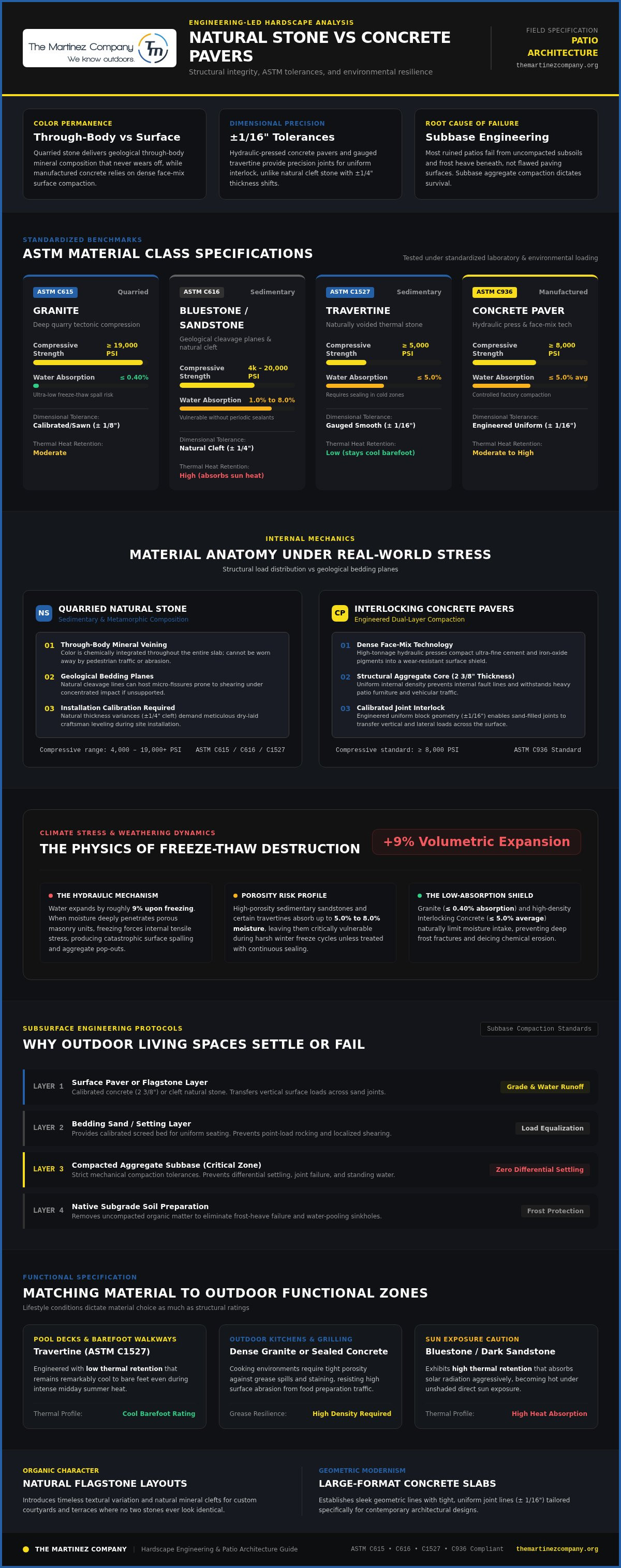
Every lasting outdoor build starts with physical material realities. When specifying natural stone vs concrete pavers for patio projects, performance begins at the elemental level. Quarried stone represents millions of years of geological sedimentation and tectonic compression. Manufactured pavers, by contrast, rely on measured aggregate blends, Portland cement, and high-tonnage hydraulic presses. Both classes deliver exceptional load-bearing strength, but their structural behaviors, dimensional tolerances, and porosity dictate how they behave under real-world conditions.
Geological Origins: Quarried Sandstone, Bluestone, Travertine, and Granite
Metamorphic and sedimentary formations create organic mineral veining, unique fissures, and natural cleft textures that factory molds can't genuinely replicate. Slabs extracted from deep quarry veins possess authentic density and through-body composition that never wears away. Because natural cleavage planes produce slight variations in slab thickness, dry-laid installations require meticulous leveling by skilled craftsmen. No two quarried flags will ever look identical, lending an enduring architectural permanence to custom courtyards and terraces.
Engineered Composition: Hydraulic Pressure, Aggregates, and Portland Cement
Manufactured concrete pavers eliminate dimensional guesswork. Automated batching facilities compact dry-cast cement, select aggregate, and iron oxide pigments under extreme hydraulic vibration. Modern face-mix technology deposits a dense, ultra-fine layer of cement and rich color atop a structural aggregate core, boosting surface durability against surface abrasion. Uniform block geometry allows sand-filled joints to transfer vertical and lateral loads across the entire hardscape surface, delivering predictable structural stability across vast pedestrian expanses.
Durability, Weathering, and Climate Resilience Under Real-World Stress
Harsh weather strips away superficial beauty. When weighing natural stone vs concrete pavers for patio construction, environmental stress acts as the ultimate proving ground. Relentless winter freeze-thaw cycles, corrosive deicing chemicals, and intense solar radiation relentlessly test your surface. Long-term performance depends on how each material handles thermal shifts and water penetration.
Compressive Strength Ratings and Heavy Surface Load Capacities
Manufactured concrete pavers must achieve a verified minimum compressive strength of 8,000 psi under ASTM C936 standards. Quarried granite pushes past 19,000 psi. Raw compressive ratings don't tell the whole story, though. Natural stone contains geological bedding planes and latent micro-fissures that can shear under localized impact. Engineered concrete units provide uniform internal density throughout their standard 2 3/8-inch thickness. This structural uniformity prevents hidden fault lines from fracturing under heavy patio furniture or vehicular traffic.
Porosity, Moisture Absorption, and Freeze-Thaw Resistance
Water expands by roughly 9% when freezing. If moisture penetrates deep into a paving unit, that expansion causes catastrophic surface spalling and aggregate pop-outs. High-porosity sedimentary sandstones and certain travertines absorb substantial moisture, leaving them vulnerable during severe cold snaps unless sealed repeatedly. Interlocking concrete pavers, engineered with controlled water-cement ratios and density additives, cap average absorption at 5%. For homeowners commissioning integrated hardscapes, consulting with master builders like The Martinez Company ensures stone selection matches sub-zero climate demands without risking premature structural degradation.
Thermal Behavior: Surface Heat Retention and Barefoot Comfort
Direct sun exposure creates another operational hurdle. Dark-toned concrete pavers act as thermal sponges, storing intense heat and radiating it back upward during peak summer afternoons. In contrast, light-colored travertine and dense sandstone maintain low surface temperatures through superior solar reflectance. Travertine stays cool to the touch even under blistering heat. For poolside applications and open dining terraces, natural stone provides dependable barefoot comfort, while textured concrete finishes offer superior slip resistance when wet.
Architectural Aesthetics: Organic Character vs Geometric Modernism
Architecture should never feel accidental. When curating natural stone vs concrete pavers for patio environments, you are establishing the visual anchor for your entire exterior footprint. Surface texture and joint geometry define the character of an outdoor living space, whether you are extending a modern interior onto a crisp terrace or framing a custom outdoor kitchen against lush natural scenery.
Color Permanence, UV Exposure, and Natural Patina Development
Geological stone possesses mineral coloration that runs straight through its core. Decades of intense sunlight won't bleach authentic granite, slate, or quartzite. Environmental weathering enriches native veining, creating a refined patina over time. Manufactured concrete pavers rely on synthetic iron-oxide pigments bound in a cementitious matrix. While modern face-mix technology dramatically extends color retention, prolonged ultraviolet exposure and continuous foot traffic will slowly soften bold tones over decades, gradually revealing underlying sand aggregates unless protected with routine penetrating sealers.
Design Flexibility: Modular Grid Systems vs Organic Irregular Masonry
Dimensional uniformity unlocks crisp geometric discipline. Calibrated concrete slabs spanning 24-by-24 or 24-by-36 inches create continuous planes with razor-sharp joint lines, pairing naturally with modern transitional architecture and minimalist outdoor structures. Irregular flagstone layouts take the opposite approach. Hand-dressed, organic stones break away from rigid grids, celebrating varied joint widths and natural cleft surfaces that nestle into rustic gardens, curved fire features, and biophilic estate settings.
The most compelling outdoor transformations often discard the idea that you must choose only one material class. Master builders frequently pair calibrated concrete borders with textured natural stone inlays. This hybrid approach delivers the clean structural lines necessary for perimeter retaining walls and outdoor kitchens while preserving the timeless warmth of geological stone where guests gather.
Subbase Engineering, Installation Protocols, and Maintenance Demands
A patio never fails from the top down; it fails from the ground up. Whether selecting natural stone vs concrete pavers for patio spaces, structural stability relies entirely on subbase aggregate mechanics. Skipping proper site preparation or rushing excavation leads directly to rutting, standing water, and joint failure within a few short seasons.
The Structural Subbase: Excavation, Compaction, and Geotextiles
Every lasting installation demands excavation down to undisturbed, load-bearing subgrade soil. Laying a heavy-duty geotextile membrane across the excavated trench stops native clay and silt from migrating upward into your aggregate foundation. Contractors must place crushed stone in successive lifts, consolidating each pass with mechanical vibratory compactors to reach 98% Standard Proctor density. This meticulous foundation eliminates settlement and establishes strict surface drainage slopes away from home foundations.
Bedding Layers and Joint Stabilization: Polymeric Sand vs Mortar Beds
Directly above the compacted aggregate rests a screeded, uniform one-inch bedding layer of coarse concrete sand conforming to ASTM C33 specifications. Interlocking concrete units and gauged stone set into this bedding, locked in place by advanced polymeric sand that hardens to resist joint washout and insect tunneling. Irregular, heavy natural flagstones frequently demand a wet-laid assembly, mortared securely over a reinforced concrete pad to guarantee flat pedestrian transitions.
Long-Term Upkeep: Sealing Frequencies, Efflorescence, and Pressure Washing
Newly installed concrete pavers often produce efflorescence, an organic salt deposit that rises through surface pores and dissipates naturally over time. Porous geological stones avoid efflorescence, but they require breathable penetrating sealers every two to three seasons to prevent staining from red wine, cooking grease, and leaf tannins. Routine cleaning requires gentle fan-tip power washing to preserve joint stabilization sands.
Flawless ground preparation distinguishes temporary landscaping from permanent architectural construction. If you want a structurally sound outdoor terrace or luxury living environment engineered to survive shifting soils, partner with our outdoor living specialists to build your hardscape on an unyielding foundation.
Strategic Selection: Aligning Hardscape Materials with Your Lifestyle
Every outdoor environment serves a distinct daily purpose. Rather than viewing natural stone vs concrete pavers for patio construction as a simple catalog debate, match the physical traits of each material directly to how you live outside. A patio that performs brilliantly for a quiet garden reading nook might fail miserably under the grease and heavy foot traffic of a busy outdoor cooking area.
Functional Zone Demands: Culinary Spaces, Fire Features, and High-Traffic Paths
Culinary spaces require dense, stain-resistant surfaces. High-performance concrete pavers treated with specialized factory sealers shrug off hot grill grease, red wine spills, and acidic citrus drips far better than soft, porous sedimentary limestones. Fire features demand high thermal tolerance. Dense granite, quartzite, and heat-resistant natural slabs excel directly around custom fire pits, resisting localized heat cracking while establishing a distinct gathering hearth. In primary pedestrian walkways, calibrated pavers eliminate tripping hazards, maintaining an even grade that allows patio chairs and wheeled carts to roll without catching edge lippage.
The General Contractor Advantage: Achieving Flawless Outdoor Precision
Master-level outdoor spaces are rarely isolated slabs of stone. They represent complete, integrated outdoor living environments that bring together custom outdoor kitchens, overhead shade pergolas, architectural retaining walls, and perimeter fencing. Executing these multi-faceted environments requires general contracting expertise to manage structural loads and transitions across disparate materials.
Use this evaluation matrix to align your lifestyle needs with the right surface:
Outdoor Culinary Hubs: Select dense, factory-sealed concrete pavers to resist hot fat splatters and simplify regular degreasing.
Barefoot Pool Decks: Choose light-toned travertine or cool-touch sandstone to minimize thermal retention during peak afternoon sun.
Integrated Architectural Builds: Coordinate paver subbase depths with custom pergolas, masonry structures, and surrounding grade elevations.
Estate Fire Pits: Anchor the seating footprint with dense, heat-resilient quarried granite or bluestone slabs that welcome open sparks.
A successful build translates your conceptual vision into permanent, load-bearing architecture. By prioritizing structural execution and zone-specific functionality, your finished hardscape delivers uncompromising performance that enriches your daily routine for decades.
Build Your Outdoor Living Vision on an Uncompromising Foundation
Selecting natural stone vs concrete pavers for patio architecture isn't a contest of which surface looks better in a showroom. It's an engineering decision. Enduring outdoor permanence comes down to aligning material density with local freeze-thaw extremes, managing moisture absorption, and executing an aggregate subbase compacted to structural perfection. Whether you prioritize the through-body geological character of quarried stone or the crisp geometric alignment of modern concrete units, the ground beneath dictates your success.
With over a decade of master-level general contracting experience, our nationwide teams build outdoor living environments that withstand shifting soils and relentless seasonal weather. Don't leave your structural investment to chance. Partner with The Martinez Company to engineer your custom outdoor living sanctuary, and turn your architectural vision into an enduring physical reality.
Frequently Asked Questions
Which patio material is more durable: natural stone or concrete pavers?
Both materials deliver exceptional durability, but their longevity profiles differ based on density and installation. High-density quarried stone like granite or quartzite can endure for a century due to its raw geological hardness. High-strength interlocking concrete pavers provide dependable service life spanning several decades under heavy foot traffic. True long-term durability hinges primarily on proper subbase aggregate compaction rather than the surface material alone.
Do concrete pavers fade or lose their original color over time?
Yes, concrete pavers experience subtle surface lightening over extended exposure to direct sunlight and weather. Manufactured units use iron-oxide pigments bound within a cement matrix. While modern face-mix technology concentrates rich pigment on the top wear layer, decades of foot traffic and UV rays gradually expose underlying sand aggregates. Natural stone features through-body geological coloration that never fades from sun exposure.
Can natural stone pavers crack during freezing winter weather?
Natural stone can crack during winter if porous slabs absorb water that subsequently expands during freeze-thaw cycles. Sedimentary varieties like low-density sandstone and unfilled travertine absorb moisture readily. When frozen, trapped moisture triggers surface flaking, delamination, or structural splitting along natural cleavage planes. High-density stones like granite or properly sealed bluestone resist freeze-thaw cycles effectively, making material density evaluation essential in cold climates.
Is it necessary to seal both concrete pavers and natural stone patios?
Sealing isn't strictly mandatory for structural stability, but it's vital for protecting surface aesthetics and extending lifespan. When evaluating natural stone vs concrete pavers for patio longevity, breathable penetrating sealers protect porous natural rock from barbecue grease, leaf tannins, and acidic spills. Concrete pavers benefit from sealers that lock in joint sand, retard surface aggregate erosion, and preserve rich pigment tones against continuous sunlight.
How do installation labor demands differ between natural stone and concrete pavers?
Natural stone installations require significantly more specialized masonry labor than manufactured concrete pavers. Irregular stone thicknesses require individual hand-leveling, sorting, and chisel-dressing to ensure smooth surface transitions and prevent tripping hazards. Concrete pavers feature uniform dimensional tolerances that allow rapid screeded sand bedding, consistent alignment, and efficient joint sanding. This manufacturing consistency streamlines construction, whereas natural stone demands master-level stonecraft.
Which paver material stays cooler under direct summer sun?
Light-colored natural stone, particularly travertine and light sandstone, stays dramatically cooler under intense sunlight than standard concrete pavers. Travertine features high solar reflectance and low thermal conductivity, making it the premier choice for barefoot pool surrounds and unshaded gathering terraces. Darker concrete pavers absorb solar radiation and retain high surface temperatures well into the evening, creating uncomfortable barefoot heat without shade structures.
What type of base foundation is required underneath outdoor patio pavers?
A durable patio requires an excavated, multi-layered foundation of crushed aggregate compacted over geotextile fabric. Specifying natural stone vs concrete pavers for patio construction still demands a crushed stone subbase compacted to 98% Standard Proctor density. A uniform one-inch bedding layer of coarse concrete sand sits above this aggregate base, supporting dry-laid pavers and providing critical sub-surface drainage away from your home.


Comments