
The 2026 Outdoor Kitchen Appliances Guide: Engineering the Ultimate Backyard Suite
An indoor refrigerator placed on a patio isn't just a convenience; it's a liability that will likely fail before the first season ends. Many homeowners assume that any stainless steel appliance can withstand the elements. This is a dangerous misconception. You want a space that functions with the same precision as your indoor kitchen while standing up to the relentless humidity and temperature swings of the open air. This outdoor kitchen appliances guide bridges the gap between high-end design and rugged engineering to ensure your investment remains a permanent fixture of your home. We understand the anxiety of utility complexity and the fear of equipment failure.
We'll show you how to select components that offer both aesthetic finality and structural integrity. You'll master the technical requirements for 304-grade materials, understand the necessity of professional utility integration, and learn why a stable concrete foundation is the bedrock of any high-performance suite. From the rise of dedicated pizza ovens to the 2026 trend of "Cloud Dancer" white finishes, we're providing the roadmap to transform your backyard into a durable culinary sanctuary. Build it once. Build it right.
Table of Contents
Understanding the Outdoor-Rated Standard
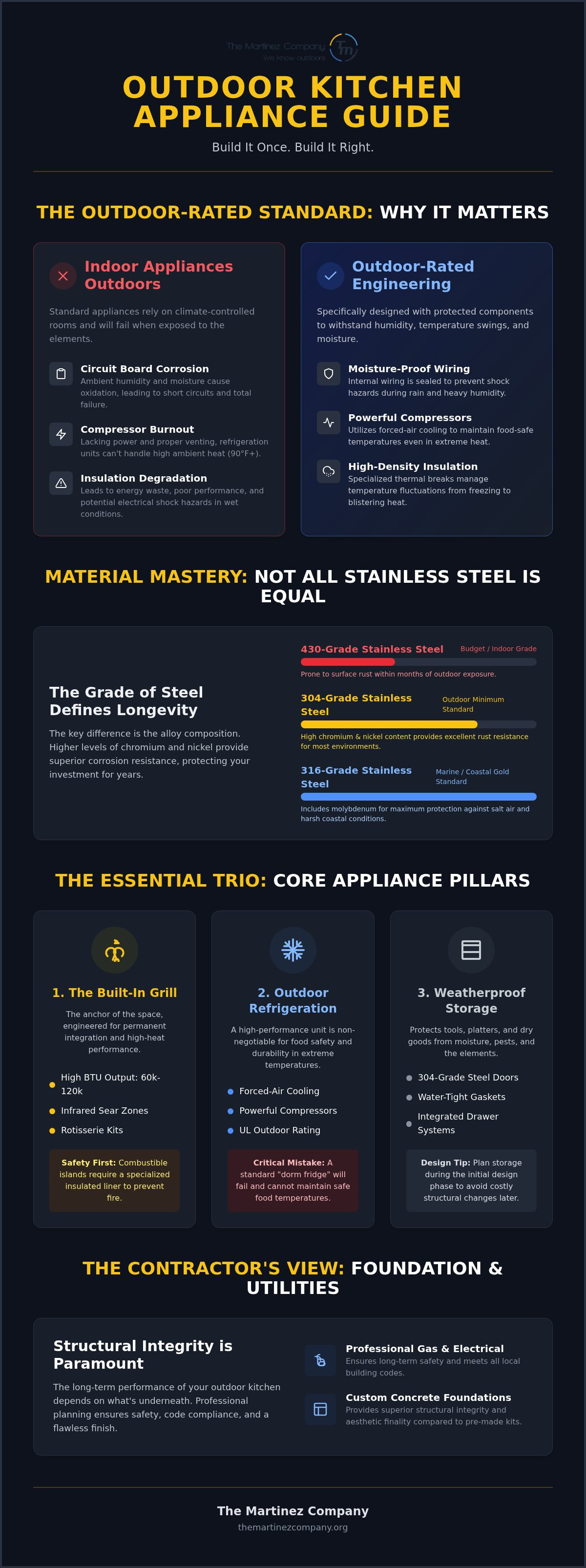
An appliance isn't outdoor-rated just because it's sitting on a patio. True outdoor engineering requires a fundamental shift in how internal components are protected from the environment. Indoor models rely on climate-controlled rooms to function properly. Outside, those same machines face humidity, salt air, and extreme heat that rapidly degrades standard insulation and sensitive electronics. This outdoor kitchen appliances guide focuses on the rigorous standards required to ensure your backyard suite remains a high-performance sanctuary for decades rather than a single season.
Indoor appliances fail in the open air for several specific reasons. Corrosion is the primary silent killer; standard circuit boards aren't coated to resist moisture, which leads to inevitable short circuits. Most indoor refrigeration also lacks the powerful compressors needed to maintain food-safe temperatures when the ambient air hits 90 degrees or higher. To ensure safety and longevity, always look for UL or ETL marks specifically designated for outdoor use. These listings confirm the unit passed testing for rain penetration and electrical safety in wet conditions. Common failure points include:
Circuit board oxidation caused by ambient humidity and temperature swings.
Compressor burnout from inadequate venting or insufficient heat-load capacity.
Insulation degradation that leads to dangerous electrical leakage and energy waste.
The Science of Weather-Resistance
Outdoor units utilize specialized thermal breaks and high-density insulation to manage brutal temperature fluctuations. Their internal wiring is moisture-proof, ensuring the machine doesn't become a shock hazard during a heavy summer storm. The National Electrical Manufacturers Association (NEMA) rating system provides a standardized scale for measuring how effectively an electrical enclosure protects against external factors like water, dust, and ice. By adhering to these standards, manufacturers create machines that can survive the transition from freezing winter nights to blistering summer afternoons without losing structural integrity.
Material Mastery: Why Grade Matters
Not all stainless steel is created equal. 304-grade stainless steel contains higher levels of chromium and nickel, making it far superior to the 430-grade often found in budget models. While 430-grade might look identical on the showroom floor, it will likely develop surface rust within months. For coastal environments, marine-grade 316 stainless is the gold standard for permanence. When you are researching different types of barbecue grills, always prioritize the chassis material over secondary features. This outdoor kitchen appliances guide recommends 304-grade as the minimum standard for any permanent installation. UV-resistant finishes are also critical for components like refrigerator gaskets and control knobs, preventing them from becoming brittle under direct sunlight.
The Essential Trio: Core Outdoor Appliances
Every high-performance culinary sanctuary relies on three foundational pillars: heat, cold, and storage. These core components define the workflow and longevity of your build. While many homeowners start with a grill, the integration of all three creates a true suite. This outdoor kitchen appliances guide focuses on selecting the right trio to ensure your space is as functional as it is beautiful. If you're planning a phased build, you must account for these elements during the initial design to avoid costly structural alterations later.
Built-In Grills: Gas vs. Pellet vs. Charcoal
The built-in grill is the anchor of the space. Unlike freestanding models, built-in units are engineered for permanent integration into masonry or metal islands. Safety is paramount here. If your island uses combustible materials, you must install a specialized insulated liner to prevent fire hazards. Premium grills typically offer a BTU output between 60,000 and 120,000, providing the heat needed for professional-grade searing. Modern builds often incorporate infrared sear zones for precision crusting and rotisserie kits for slow-roasting, turning a standard grill into a versatile cooking station.
Refrigeration That Defies the Heat
Choosing a standard "dorm fridge" for an outdoor island is a catastrophic mistake. These units lack the insulation and powerful compressors required to maintain food safety when ambient temperatures soar. Professional outdoor refrigeration utilizes forced-air cooling, which circulates chilled air more effectively than cheaper cold-plate models. This ensures the unit recovers its internal temperature quickly after the door is opened. Proper ventilation is also a non-negotiable requirement to prevent compressor burnout. To ensure your project meets all safety standards, consult the outdoor kitchen building codes during the design phase.
Weather-proof storage completes the trio. Precision-engineered 304-grade stainless steel drawers protect your tools and dry goods from rain, dust, and pests. High-quality seals and magnetic latches are essential for maintaining a clean environment. If you are designing for a large family, prioritize cabinets with a deeper footprint to house oversized platters. For those seeking a seamless transition from concept to completion, our team at The Martinez Company can help you engineer a layout that balances immediate needs with long-term goals. We prioritize structural stability so your appliances perform flawlessly for years. Building a durable suite starts with a clear roadmap and the right materials.
Specialty Additions for the High-End Entertainer
Beyond the foundational trio of the grill, fridge, and storage, specialty appliances transform a standard patio into a professional-grade venue. These additions allow you to move the entire culinary process outdoors. This outdoor kitchen appliances guide explores the engineering behind these luxury features. Many homeowners view these as "nice-to-haves" that can be added as budgets grow. This is a common misconception that leads to expensive retrofitting. Adding a built-in pizza oven or a power burner later often requires tearing into existing masonry and concrete foundations to accommodate new weight loads and utility lines.
The Wood-Fired Experience: Pizza Ovens
Pizza ovens are the rising stars of 2026 backyard transformations. They offer a social cooking experience that a standard grill cannot replicate. Whether you select a wood-fired or gas-assisted model, structural considerations are paramount. A built-in pizza oven is a massive piece of equipment that requires a reinforced concrete foundation to prevent settling. Heat clearance is equally critical. Custom masonry designs must include proper ventilation and thermal barriers to protect adjacent appliances and cabinetry. Without these safeguards, the intense heat can cause structural cracking or component failure.
Liquid Assets: Beverage and Ice Management
Designing the ultimate social hub requires a dedicated focus on beverage management. A standard refrigerator isn't enough for high-capacity hosting. Dedicated ice makers are essential; they can produce significant amounts of ice daily but require a reliable drain. Kegerators are another popular addition, featuring weather-proof tap towers and specialized insulation to keep lines cold during summer peaks. Integrating these into a cocktail station with a sink creates a seamless workflow for the entertainer. These units require precise electrical engineering and GFCI protection to ensure safe operation in wet environments.
Expanding your culinary range also involves high-performance side burners and warming drawers. Power burners are designed for high-heat tasks like boiling large pots of water or stir-frying in a wok. Warming drawers are the secret weapon for large gatherings, keeping the first course at a safe temperature while the rest of the meal finishes on the grill. Integrating these specialty items during the initial build ensures aesthetic finality and structural integrity. Every addition should be part of a cohesive plan that prioritizes permanence and performance. Don't let your dream suite be limited by a lack of foresight during the construction phase.
The Contractor Perspective: Utilities and Structural Integration
The most sophisticated appliances in the world will fail if the underlying infrastructure is flawed. Structural integration is where high-end design meets the rugged reality of construction. This outdoor kitchen appliances guide emphasizes that utility planning is a prerequisite for a successful build. You cannot treat gas lines and electrical circuits as afterthoughts. They must be engineered into the foundation. Precision concrete flatwork is the silent hero of this process. If your slab isn't perfectly level, your refrigeration doors won't seal properly and your grill won't drain grease as intended, leading to premature equipment failure.
Utility Rough-In: The Pre-Pour Protocol
Utility planning must precede the custom concrete island build to avoid the nightmare of jackhammering a finished slab. Gas line logistics depend on whether you choose natural gas or liquid propane. Natural gas offers the convenience of an endless supply but requires professional trenching and permanent piping. Propane is more flexible but requires dedicated, vented storage within the island structure. While we don't provide plumbing services, we coordinate the necessary drainage for ice makers and sinks into the structural layout. A Safety Zone is a designated, easily accessible area located at least three to five feet away from the heat source where gas shut-off valves must be installed for immediate emergency access. Electrical engineering is equally vital. Every outlet requires GFCI protection, and dedicated circuits are necessary for high-draw items like electric smokers or power burners.
Ventilation and Airflow Mastery
If you're building under a covered patio, a professional ventilation hood is non-negotiable. It mitigates smoke and prevents grease from staining your ceiling or structural beams. Airflow management also applies to the island itself. Island vent panels are required every four to six feet to prevent dangerous gas buildup and heat traps. This is especially critical for propane, which is heavier than air and can pool in low spots. Proper clearance between your grill and any combustible structures ensures your sanctuary remains safe. For homeowners ready to transition from abstract ideas to a permanent physical structure, The Martinez Company provides the professional contracting expertise needed to manage these complex integrations. We ensure every line is accurate and every foundation is stable.
Realizing Your Vision with The Martinez Company
Building a culinary sanctuary is about more than buying expensive hardware. It's about ensuring those pieces of equipment sit on a foundation that won't shift, crack, or settle over time. The Martinez Company approach is defined by stability, perfection, and precision. While DIY island kits offer a tempting shortcut, they often lack the structural integrity required for a permanent installation. These pre-made systems don't account for the unique terrain of your property or the specific utility requirements of high-end appliances. A professional general contracting approach ensures that every utility line, masonry joint, and concrete pour is executed with aesthetic finality. We don't just assemble components. We engineer a permanent structural reality that enhances your home's value.
The Anatomy of a Professional Build
Our process centers on custom concrete mastery. Since 2014, we've focused on the "how" of the build, ensuring that your foundation is as durable as the 304-grade stainless steel it supports. We coordinate the complex integration of high-BTU grills and specialized refrigeration with your masonry needs. A Reliable Visionary understands that a successful project requires a protective expert's eye. We watch for the subtle details that lead to long-term longevity. This includes ensuring your concrete flatwork is perfectly level so your appliances perform exactly as the manufacturer intended. If the slab is off by even a fraction of an inch, your refrigerator doors won't seal and your drainage will fail. Your investment deserves a structure that stands the test of time and weather without hesitation.
Your Next Steps in Backyard Transformation
Moving from an abstract backyard concept to a completed physical result requires clear communication and methodical execution. We begin by consulting on your specific layout and material selection to ensure your outdoor kitchen appliances guide becomes a reality. We help you navigate the technical requirements for gas and electrical needs while keeping your unique lifestyle goals at the center of the plan. It's time to stop worrying about appliance failure and start focusing on the hosting possibilities of a high-performance suite. Accuracy and permanence are the core values of every project we touch. We take the anxiety out of utility integration by managing the transition from concept to construction with rugged confidence.
Your backyard is an extension of your home's legacy. Don't settle for temporary structures that will degrade in a few seasons. Schedule your consultation with The Martinez Company today to begin the process of building a durable, high-performance sanctuary. Let's build something that lasts.
Building Your Legacy in the Open Air
Engineering a professional-grade culinary suite is a commitment to permanence and lifestyle transformation. You've learned that 304-grade stainless steel and UL-rated components are the non-negotiable baseline for durability. This outdoor kitchen appliances guide has highlighted that true performance rests on a foundation of precise utility planning and custom concrete mastery. Success isn't found in a pre-made box; it's found in the structural integrity of a build that accounts for every gas line and electrical circuit before the first slab is poured. Don't let a generic DIY kit compromise the safety or longevity of your vision.
Since 2014, we've specialized in transforming abstract backyard concepts into structural realities with a focus on stability and perfection. We understand that your outdoor sanctuary is an investment in your home's future and your family's social life. Our team brings the rugged confidence of seasoned contractors to every custom build, ensuring your appliances perform flawlessly for decades. It's time to move past the planning phase and start the actual construction of your high-performance retreat. Architect your dream outdoor sanctuary with The Martinez Company. Your ideal backyard is closer than it's ever been. Let's make it permanent.
Frequently Asked Questions
Can I use regular indoor appliances in an outdoor kitchen?
No. Indoor appliances lack the insulation, moisture-proof wiring, and powerful compressors required for external environments. Exposure to humidity and temperature swings will cause electrical failure and corrosion within months. Using them outdoors also voids manufacturer warranties and creates significant safety hazards for your family. Always select UL-rated equipment specifically designed for the rigors of your climate to ensure long-term performance and peace of mind.
What is the best material for an outdoor kitchen island foundation?
Reinforced concrete is the superior choice for a permanent island foundation. It provides the necessary structural integrity to support the massive weight of masonry and high-end appliances. Unlike wood or light-gauge metal frames, a custom concrete slab won't rot, warp, or shift over time. Proper professional flatwork ensures the surface is perfectly level, which is critical for the correct operation and drainage of your grill and refrigeration units.
Do I need a vent hood for my outdoor grill?
You must install a vent hood if your grill is located under a patio cover, pavilion, or any overhead structure. This is a non-negotiable safety requirement to mitigate smoke and prevent grease accumulation on your structural beams. Without proper ventilation, smoke can pool under the roof, creating a fire hazard and staining your expensive finishes. Ensure the hood is wider than the grill to capture all rising heat effectively.
What is the difference between 304 and 430 stainless steel?
The primary difference lies in the chemical composition and corrosion resistance. 304 stainless steel contains higher levels of chromium and nickel, making it nearly impervious to rust in most environments. 430 stainless steel is a budget-friendly alternative that lacks these protective elements, leading to surface oxidation within a single season. This outdoor kitchen appliances guide recommends 304-grade as the minimum standard for any permanent backyard suite to ensure aesthetic finality.
Is a permit required for an outdoor kitchen installation?
Most municipalities require building permits for any project involving new gas, electrical, or water lines. Regulations vary by location, but the International Code Council sets standards that many local building departments strictly follow. Failing to secure the necessary permits can lead to expensive fines and significant complications during a future home resale. Always check with your local building department or Homeowners Association (HOA) before breaking ground on your new project.
How do I protect my outdoor appliances during the winter?
Protection begins with a thorough cleaning and the application of a high-quality stainless steel protectant. You should shut off the water supply to ice makers and sinks to prevent pipes from bursting in freezing temperatures. Custom-fit, weather-proof covers are essential for shielding the chassis from snow and ice during the off-season. For refrigeration units, it's best to unplug them if the ambient temperature remains consistently below 40 degrees Fahrenheit.
What utilities are needed for a fully functional outdoor kitchen?
A comprehensive setup typically requires natural gas or liquid propane, 120V electrical circuits with GFCI protection, and a reliable water line. Gas lines power the grill and specialty burners, while electricity is necessary for refrigeration, lighting, and rotisserie kits. This outdoor kitchen appliances guide emphasizes that these utilities must be roughed-in before the concrete is poured to ensure a seamless and structurally sound final result that stands the test of time.
How much clearance is needed between a grill and a patio cover?
Most manufacturers recommend a minimum of 36 to 48 inches of vertical clearance between the grill surface and a non-combustible patio cover. If the cover is made of wood or other combustible materials, you must install an insulated jacket and a high-capacity vent hood to prevent fires. Always consult the specific installation manual for your appliance to ensure compliance with safety codes and to prevent structural damage from intense heat.


Comments