
Sealing Concrete Driveways for Winter: 2026 Guide
Your driveway isn't just a path to your garage; it's a structural asset currently sitting at the mercy of internal hydraulic pressure. When moisture penetrates the pores of your slab and freezes, the resulting expansion creates thousands of pounds of force that can shatter even the most robust concrete from the inside out. You likely dread the sight of new cracks and surface spalling that appear every spring, yet the confusion over which products actually repel salt often leads to costly inaction. We understand that your home demands stability and perfection. This 2026 guide will teach you the professional protocol for sealing a concrete driveway for winter, transforming a vulnerable surface into an impenetrable barrier.
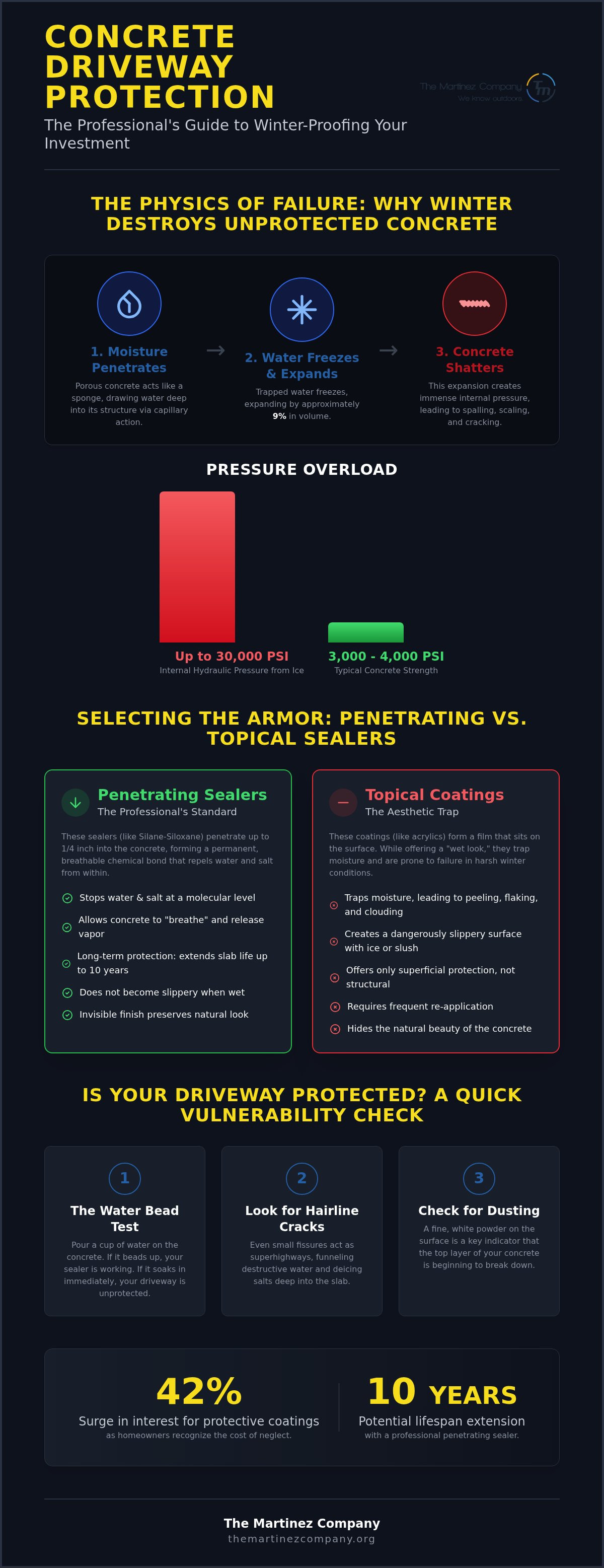
Interest in protective coatings has surged by 42 percent this year as homeowners realize that a single season of neglect can lead to expensive replacements. We'll show you how to choose high-performance penetrating sealers that offer a lifespan extension of up to ten years. You'll gain a clear timeline for application and a deep understanding of the ROI behind professional-grade maintenance. By following this expert framework, you'll ensure your property remains pristine long after the final snowmelt.
Table of Contents
The Physics of Failure: Why Winter Destroys Unprotected Concrete
Concrete is a porous material that functions like a rigid, structural sponge. While it appears impenetrable, its internal matrix is filled with microscopic voids. Capillary action pulls moisture deep into these pores, where it remains trapped. When temperatures drop, this water freezes and expands by approximately nine percent. This expansion generates up to 30,000 PSI of internal hydraulic pressure. Most residential concrete slabs are engineered to withstand only 3,000 to 4,000 PSI. The math is clear; the internal force of freezing water simply shatters the concrete from the inside out.
You see the consequences of this pressure through spalling and scaling. Spalling occurs when large, circular fragments of the surface pop out, often revealing the aggregate beneath. Scaling is the progressive peeling of the top finished layer. Both symptoms indicate that the structural integrity of your slab is failing. The 2026 winter season presents unique challenges for older concrete. Increased precipitation patterns and rapid temperature swings accelerate the number of freeze-thaw cycles your driveway must endure. Properly sealing a concrete driveway for winter is the only way to stop this cycle of destruction before it begins.
The Chemical Threat: Deicers and Road Salts
Deicers like calcium chloride and sodium chloride are essential for safety, but they are devastating to concrete. Salt is hygroscopic, meaning it attracts and holds water within the concrete matrix. This creates a "sub-surface freeze" phenomenon where the interior of the slab stays saturated even when the surface appears dry. This moisture retention increases the number of freeze-thaw cycles exponentially. New concrete is especially vulnerable to these chemical attacks. Because it hasn't reached its maximum density, salt can penetrate deeper and faster than it would in a seasoned slab.
Identifying Vulnerability Before the First Frost
You can diagnose your driveway's health with a simple "Water Bead Test." Pour a cup of water onto several sections of your driveway. If the water beads up and sits on the surface, your current sealer is still performing. If it soaks in and darkens the concrete immediately, your slab is unprotected. Beyond the bead test, look for these visual cues:
Hairline Cracks: These small fissures act as high-speed highways for ice and salt.
Dusting: A fine white powder on the surface indicates the top layer is beginning to break down.
High Porosity: Broom-swept finishes have more surface area and catch more water than smooth surfaces.
Identifying these issues early allows for the precision application required when sealing a concrete driveway for winter. Professional-grade protection ensures that your investment survives the harshest months without structural compromise.
Selecting the Armor: Penetrating Sealers vs. Topical Coatings
Choosing the right product is a decision that determines whether your driveway thrives or degrades over the next decade. At The Martinez Company, we utilize penetrating sealers as our professional standard. Unlike topical coatings that merely rest on the surface, penetrating agents move deep into the substrate to create a permanent chemical bond. This approach is vital when sealing a concrete driveway for winter because it addresses the internal vulnerabilities of the slab rather than just masking them with a temporary film.
Topical acrylics are frequently requested for their "wet look" and high-gloss finish. While aesthetically striking, these films create a non-breathable layer that can trap moisture. During extreme 2026 temperature swings, this trapped vapor expands and causes the sealer to flake, peel, or cloud. More importantly, topical coatings can become dangerously slippery when covered in ice or slush. For high-traffic residential areas, we prioritize structural integrity and safety over superficial shine. Silane-Siloxane blends represent the gold standard for salt protection, combining deep penetration with surface-level water repellency. Reactive silicates take this a step further by reacting with free lime in the concrete to increase density at a molecular level, filling the pores with a crystalline structure that resists chemical attack.
The Chemistry of Hydrophobic Barriers
Silane molecules are exceptionally small, allowing them to penetrate up to 1/4 inch into the concrete matrix. This creates a hydrophobic barrier that is entirely breathable; it allows moisture vapor to escape from within the slab while preventing liquid water and deicing salts from entering. If you use a vapor-impermeable trap, you risk delamination and surface failure. Our professional concrete services prioritize these breathable, high-performance chemistries to ensure your driveway remains stable through every freeze-thaw cycle.
Choosing Based on Concrete Age and Condition
Timing is critical for new installations. You must follow the 28-day curing rule before applying any permanent sealant. Applying a product too early traps hydration water and weakens the final structure of the concrete. For older, weathered driveways, we often use a higher concentration of solids to rejuvenate the surface and bridge microscopic fissures. An essential part of sealing a concrete driveway for winter is assessing the current porosity of the slab to ensure the "armor" you choose can actually take hold and provide the permanence your property deserves.
The 2026 Application Window: Timing and Environmental Constraints
Precision timing is the difference between a permanent shield and a wasted investment. When sealing a concrete driveway for winter, you aren't just racing against the first snowfall; you're managing complex chemical evaporation rates. The "50-and-Rising" rule is your primary safeguard. Air temperatures must be at least 50°F and climbing during the entire application process. In 2026, modern low-VOC formulations require specific thermal conditions to cure correctly. If the environment is too cold, the carrier agents won't evaporate from the slab, leaving you with a tacky, clouded finish that fails long before the spring thaw.
You also need a guaranteed 48-hour dry window. Any precipitation within two days of application can emulsify the sealer, effectively washing away your protection before it bonds. Monitoring the dew point is equally critical for success. If the surface temperature of your concrete drops within 5 degrees of the dew point, microscopic condensation forms on the surface. This invisible moisture layer prevents the sealer from penetrating the pores, trapping water beneath the barrier and causing premature delamination.
Surface Temperature vs. Ambient Temperature
Concrete functions as a massive thermal sink. It retains cold far longer than the surrounding air. On a crisp autumn morning, the air might reach a comfortable 55°F, but the slab itself could still be trapped at 40°F. Professional contractors use infrared thermometers to ensure the concrete has reached the necessary threshold for absorption. Conversely, on unseasonably warm fall days, sun-baked slabs can cause "flash drying." This occurs when the sealer dries on the surface before it can soak into the matrix, leading to unsightly bubbling and poor adhesion.
Late-Season Strategies: Is it Ever Too Late?
Every year, homeowners reach the "Point of No Return." If nighttime temperatures consistently drop below freezing, the risk of a failed application becomes too high to justify the cost. It's better to wait for a stable spring window than to trap ice-forming moisture inside your concrete. If you've missed the ideal window, focus on temporary winter protection. Filling large cracks with high-quality cold-patch compounds can prevent massive water ingress during the harshest months. While certain cold-weather additives can extend the application season by a few degrees, they are no substitute for a stable, dry environment. Stability is the hallmark of perfection in concrete stewardship.
The Professional Protocol: A 4-Step Sealing Masterclass
Precision is the hallmark of structural preservation. While many homeowners believe a quick power wash is sufficient, professional-grade results require a methodical approach that addresses the chemical and physical state of the slab. At The Martinez Company, we view sealing a concrete driveway for winter as a high-stakes engineering task. We follow a rigorous four-step protocol to ensure every square inch of your surface is prepared for the coming freeze.
Step 1: Deep Decontamination. We remove automotive oils, biological growth, and embedded salts that standard pressure washing leaves behind.
Step 2: Mechanical and Chemical Etching. This process opens the concrete pores, creating the necessary profile for the sealer to reach its target depth.
Step 3: Precision Application. We apply the sealer with uniform saturation, carefully managing the volume to prevent surface puddling.
Step 4: The Curing Phase. The first 24 hours are critical. We protect the surface from all traffic and moisture while the chemical bond solidifies.
Preparation: The Foundation of Perfection
Surface-level cleaning is the most common point of failure. Power washing alone cannot neutralize the acidic road salts or lift deep-seated grease that prevents sealer adhesion. You must use professional degreasers and salt-neutralizing agents to reset the concrete's pH. Before you begin the application, perform the "Plastic Sheet Test." Tape a two-foot square of clear plastic to the slab for 24 hours. If condensation appears under the plastic, the substrate still holds too much moisture. Sealing a damp slab traps water inside, which leads to the very spalling you're trying to prevent.
Application Techniques for Structural Integrity
The tools you choose dictate the depth of protection. We prioritize high-pressure pump sprayers over rollers for residential driveways. Rollers often lead to "puddling," where excess product sits on the surface rather than penetrating the matrix. A sprayer allows for a controlled, misty application that encourages the concrete to "drink" the sealer. For older or high-porosity surfaces, we utilize a "wet-on-wet" technique. This involves applying a second coat while the first is still damp, ensuring maximum intake before the pores close. If you want to guarantee your property survives the 2026 winter without compromise, trust our residential concrete services to deliver a flawless, professional execution. We focus on the gaps, joints, and hairline cracks where ice does the most damage, ensuring a seamless barrier that lasts.
Beyond the Seal: Long-Term Concrete Stewardship
Stewardship is the bridge between a temporary fix and a lifetime of structural integrity. While sealing a concrete driveway for winter provides the essential initial shield, your daily choices during the freeze determine the ultimate longevity of that investment. We believe that stability and perfection are not static states; they require a proactive maintenance mindset. By implementing a methodical schedule, you transform a simple home improvement project into a sophisticated asset management strategy that preserves your property's value. According to the American Concrete Institute, proper sealing and subsequent care can extend a driveway's lifespan by five to ten years while reducing long-term maintenance costs by up to 40 percent.
High-traffic slabs demand annual inspections to identify microscopic wear before it evolves into structural failure. Our Martinez Philosophy centers on catching hairline fissures and localized sealant depletion early. This "maintenance-first" approach prevents the need for aggressive restoration later. If you notice water darkens the surface in specific wheel-path areas, it's a signal that the protective barrier is thinning. Addressing these zones immediately ensures your concrete remains an impenetrable fortress against the elements.
Safe Winter Maintenance Practices
Your choice of deicer matters as much as the sealer itself. We rank Calcium Magnesium Acetate (CMA) as the gold standard for residential safety because it's significantly less corrosive than traditional rock salt. Sodium chloride attracts moisture and forces it deep into the concrete matrix, which accelerates the destructive freeze-thaw cycle we've worked so hard to prevent. Beyond chemicals, consider your mechanical tools. Metal-edged snow shovels are the primary cause of surface gouging on sealed driveways. Use plastic or rubber-edged shovels to clear snow without compromising the sealant layer. Once the spring thaw arrives, perform a thorough flush of the surface to remove any lingering chemical residue that could degrade the finish during the warmer months.
Architecting a Permanent Solution
There is a clear line between surface maintenance and structural necessity. If your driveway exhibits cracks wider than 1/4 inch or significant slab settlement, a simple sealant application won't suffice. These symptoms suggest underlying subgrade issues that require a professional evaluation. Our team analyzes the engineering behind every slab to determine if you need a fresh seal or a more comprehensive structural intervention. You deserve a property that stands the test of time. Ensure your home remains a testament to quality craftsmanship and durability by partnering with The Martinez Company for your next concrete project. We bring a rugged confidence to every inspection, ensuring your surfaces are built to last for decades, not just seasons.
Securing Your Structural Legacy for 2026
A pristine driveway is the result of meticulous engineering and disciplined maintenance. By understanding the physics of freeze-thaw cycles and selecting high-performance penetrating sealers, you've taken the first step toward permanent structural integrity. Remember that timing is your greatest ally; monitoring the 2026 application window ensures your barrier bonds correctly before the first deep freeze. Sealing a concrete driveway for winter isn't just a seasonal chore. It's a strategic investment in the longevity of your home's most visible asset.
At The Martinez Company, we've provided expert concrete craftsmanship since 2014. We remain committed to the structural stability and aesthetic perfection that sets national standards in high-end residential and commercial contracting. Don't leave your property's future to chance when you can rely on a visionary partner dedicated to durability. Experience the perfection of professional construction with The Martinez Company today. Your driveway represents your home's first impression; make sure it remains a testament to quality throughout every spring thaw and for many years to come.
Frequently Asked Questions
Is it better to seal concrete in the spring or the fall for winter protection?
Fall is the strategic choice for immediate winter defense. Sealing just before the freeze cycle ensures the hydrophobic barrier is at its peak strength when road salts and ice arrive. While spring is good for general maintenance, fall sealing provides the specific protection needed to prevent winter spalling and structural decay. This timing allows the product to cure perfectly before the first snowfall hits.
Can I apply concrete sealer if the temperature is below 50 degrees?
No, you should avoid application if the air or surface temperature is below 50°F. Most professional-grade sealers require this thermal threshold to cure and bond correctly at a molecular level. If it's too cold, the carrier agents won't evaporate. This results in a failed, cloudy finish that lacks the durability required for 2026 winter conditions. Stability in temperature is the key to a perfect finish.
How many coats of sealer does a concrete driveway need for maximum salt protection?
Two thin, uniform coats are the professional standard for maximum saturation. The first coat establishes the base protection, while the second "wet-on-wet" application fills any remaining microscopic voids. Applying too many coats can lead to surface buildup and peeling. Focus on achieving a deep, consistent intake rather than a thick, superficial film. This ensures the structural integrity of your driveway remains intact throughout the season.
What happens if it rains shortly after I seal my driveway?
Rain within the first 24 hours can emulsify the sealer and ruin the bond. It often results in white, cloudy spots or a complete loss of protection. If precipitation is expected, you must postpone the project. A bone-dry 48-hour window is essential for the chemical reaction to reach its final, permanent state. Protecting the surface during this critical phase is non-negotiable for a professional result.
Does sealing concrete prevent it from cracking in the winter?
Sealing significantly reduces the risk of cracks by stopping water from entering the pores. It prevents the internal 30,000 PSI of hydraulic pressure caused by the freeze-thaw cycle. While it can't fix existing structural issues or prevent cracks from ground movement, it is the primary defense against surface-level failure and spalling. Proper maintenance ensures your slab remains stable and visually perfect for years to come.
Which is better for winter: a water-based or solvent-based sealer?
Penetrating solvent-based sealers are often preferred for their deep intake and superior salt resistance. However, modern 2026 water-based formulations have closed the performance gap and offer lower VOC levels. The choice depends on your specific concrete porosity and local environmental regulations. Both can be effective when sealing a concrete driveway for winter if they utilize Silane-Siloxane chemistry. Always prioritize products that offer a breathable, hydrophobic barrier.
How long should I wait to drive on my newly sealed driveway?
You should wait at least 24 to 48 hours before allowing vehicle traffic. While the surface may feel dry to the touch within a few hours, the internal chemical bond needs time to reach full hardness. Heavy vehicles can disrupt the curing process or leave permanent tire marks if the sealer hasn't fully solidified within the matrix. Patience during the curing phase is essential for a high-end, durable finish.
Can I use salt on a sealed concrete driveway during the winter?
You can, but you should use it sparingly and choose safer alternatives. Even when sealing a concrete driveway for winter, traditional rock salt is aggressive. We recommend Calcium Magnesium Acetate (CMA) as a less corrosive option. Always flush the surface with water in the spring to remove any chemical residue that might eventually degrade the protective barrier. This proactive stewardship keeps your driveway in pristine condition long-term.


Comments