
Master Checklist: Common Concrete Pouring Mistakes to Avoid in 2026
A single hair-line fracture in your new driveway isn't just an eyesore. It's a permanent record of a mistake made during the first few hours of the pour. You've likely spent weeks planning this project and significant capital on materials, so the anxiety of watching that wet slab settle is completely natural. No one wants to invest in a structural surface only to see it spiderweb with cracks before the season ends. Understanding the common concrete pouring mistakes to avoid is the difference between a surface that fails and a legacy that lasts.
Concrete success is won in the preparation and the chemistry, not just the finish. We'll show you how to transition from a vulnerable site to a professional-grade structure by identifying the critical errors that compromise durability. This guide provides a master checklist based on the latest ACI CODE-318-25 standards to ensure your project meets the highest benchmarks of stability. You'll gain the confidence to evaluate any contractor's work and the technical knowledge to achieve a permanent, crack-free result.
Table of Contents
Pre-Pour Preparation: The Invisible Risks to Concrete Stability
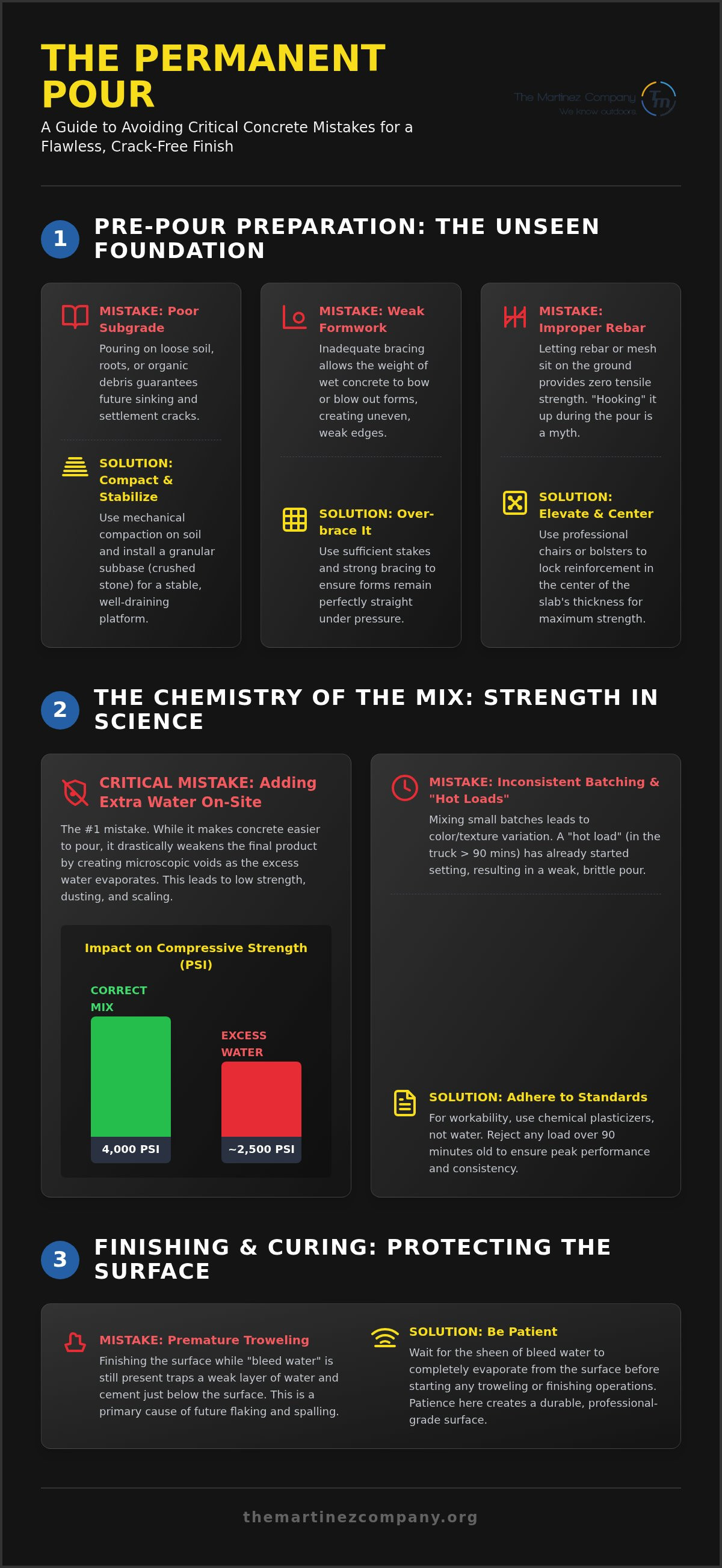
Concrete is only as strong as what lies beneath it. While the smooth finish captures the eye, the true success of a project is buried in the earth. One of the common concrete pouring mistakes to avoid is neglecting the subgrade. If you pour over loose soil or organic debris like roots and leaves, the concrete will eventually sink as that material decomposes. This oversight transforms a significant investment into a map of settlement cracks that no amount of surface repair can truly fix. Precision begins here, where the transition from raw ground to a structural foundation requires unwavering attention to detail.
Improper formwork creates another layer of risk. If the framing isn't braced with enough stakes, the weight of the wet mix causes the forms to bow or blow out entirely. This results in jagged, uneven edges and wasted material. We also utilize vapor barriers to stop moisture from migrating upward. This simple layer prevents floor covering failures and internal dampness, ensuring the aesthetic finality of the project isn't ruined by future mold or delamination.
Soil Compaction and Subbase Essentials
Identifying soft spots is a non-negotiable step for any professional build. You can't rely on hand-tamping for a structural slab because it fails to provide the density required to support thousands of pounds of wet material. Some of the most common concrete pouring mistakes to avoid often start with inadequate compaction. A granular subbase, typically comprised of crushed stone or gravel, ensures proper drainage and creates a stable platform. Without this layer, water traps beneath the slab, leading to devastating freeze-thaw damage or internal soil erosion that hollows out the structure from below.
Reinforcement Placement Errors
Steel reinforcement provides the muscle for your slab, but it's useless if it sits on the dirt. There is a persistent myth that rebar can simply be pulled up into place during the pour. It's a dangerous shortcut. To achieve true permanence, reinforcement must remain centered within the concrete. Use professional chairs or bolsters to lock the mesh at the correct height, ensuring it stays exactly where the engineering requires. Sizing your rebar for the intended load capacity is the final step in moving from a conceptual plan to a physical result that lasts for decades.
The Chemistry of the Mix: Avoiding Water-Ratio Pitfalls
Concrete isn't just a mixture; it's a precise chemical reaction. At the heart of this reaction is the water-cement ratio, defined as the weight of water divided by the weight of cement in the mix. Getting this balance right is essential for structural integrity. One of the most common concrete pouring mistakes to avoid is the temptation to add extra water on-site to improve workability. While a "soupy" mix flows more easily into forms, it comes at a steep cost to the finished product's durability.
Excess water compromises the internal matrix of the slab. As the surplus moisture evaporates, it leaves behind microscopic voids that weaken the structure. This directly correlates to a lower PSI (pounds per square inch) rating. A mix designed for 4,000 PSI might struggle to reach 2,500 PSI if too much water is introduced. Beyond strength, high water content leads to surface scaling and "dusting." This occurs when the top layer remains soft and chalky, eventually peeling away under foot or vehicle traffic. Professional concrete contracting requires a commitment to these chemical standards from the moment the truck arrives.
The Danger of On-Site Water Addition
Precision is the hallmark of high-level craftsmanship. When a truck arrives, the mix is already calibrated for specific performance standards. If the concrete feels too stiff, don't reach for the hose. Instead, professionals utilize plasticizers. These are chemical admixtures that increase flowability without compromising the water-cement ratio. This ensures the concrete reaches every corner of the formwork while maintaining its intended strength and density. It's about working smarter, not wetter. Avoiding these common concrete pouring mistakes to avoid ensures the transition from wet material to a permanent structure is seamless.
Inconsistent Batching and Mixing
Consistency is key to aesthetic finality. Mixing small batches by hand for large areas often results in varying colors and textures across the slab. This lack of uniformity is a clear sign of amateur work. You must also be vigilant about "hot loads." This refers to concrete that has sat in the drum for too long, typically over 90 minutes, causing it to begin the hydration process prematurely. These loads must be rejected. A hot load is difficult to place and will likely result in a weakened, brittle structure. Ensuring uniform color and texture across multiple truckloads requires a methodical approach to timing and delivery.
Execution and Placement: Timing the Perfect Pour
Execution is the ultimate test of preparation. You've balanced the chemistry and prepped the subgrade, but the actual pour requires military-grade timing. One of the most common concrete pouring mistakes to avoid is ignoring the clock once the truck starts spinning. Interrupted placement creates a "cold joint," which is effectively a structural crack waiting to happen. This occurs when new concrete is poured against material that has already begun to set. They don't bond. It leaves a visible line and a permanent weak point in your slab. To achieve a monolithic result, the transition from one truckload to the next must be seamless and rapid.
Protecting the reinforcement is equally vital during placement. Don't walk through the wet mix. Doing so pushes the rebar toward the subgrade, negating the precise placement on chairs you established during the prep phase. Every footprint is a potential failure point. We view every pour as a high-stakes performance where accuracy and speed must coexist to ensure structural integrity.
Weather Planning and Ambient Conditions
Successful placement depends on the elements. We often reference a calculation where the sum of ambient temperature, relative humidity, and wind speed dictates the risk of plastic shrinkage cracking. If the heat is extreme, the surface dries faster than the core, leading to a spiderweb of surface fractures. Conversely, unexpected rain during a pour can wash away the cement paste, leaving an exposed, weakened aggregate. If the forecast is uncertain, keep heavy-duty plastic sheeting on-site to shield the fresh pour immediately. For cold weather projects, maintaining hydration temperatures above 50 degrees Fahrenheit is essential. We utilize accelerators or thermal blankets to prevent the chemical reaction from stalling in the frost.
Consolidation and Air Voids
Solid concrete is dense concrete. For thick slabs and structural walls, mechanical vibration is non-negotiable. This process removes trapped air pockets and prevents "honeycombing," which are hollow voids that look like a beehive against the formwork. However, there's a fine line to walk. Over-vibration is another of the common concrete pouring mistakes to avoid. It causes the heavy aggregate to sink to the bottom while forcing the fine sands and water to the top. This separation ruins the structural balance of the mix. Proper consolidation ensures the material reaches every corner and edge of the forms, creating a structure that embodies the Martinez standard of perfection.
Finishing and Curing: Protecting the Surface Integrity
The final stage of a pour is where aesthetic finality meets structural endurance. It's the moment when a project transitions from a raw, wet mix to a polished, permanent structure. One of the most common concrete pouring mistakes to avoid is finishing the surface while it's still "bleeding." Bleed water is the excess moisture that rises to the top as heavier aggregates settle into the slab. If you work this water back into the concrete with a trowel, you dilute the surface cement paste. This creates a weak, porous top layer that will inevitably flake, peel, or "dust" under the slightest pressure. Patience is a tool as valuable as any float in your kit.
Premature troweling is the enemy of a permanent finish. Sealing the surface before the bleed water has evaporated traps moisture and air underneath the top skin. This leads to unsightly blisters and delamination that ruin the surface integrity. We also emphasize the necessity of control joints. Every slab needs room to move. By cutting joints at the correct depth and spacing, you dictate where the concrete will crack as it shrinks, preserving the visual perfection of the rest of the surface.
The Bleed Water Waiting Game
Identifying the exact moment to begin finishing is an art form rooted in science. You must wait until the surface sheen disappears and the concrete can support the weight of a finisher without leaving deep indentations. Rushing this process is a hallmark of amateur work. Proper bull-floating should happen immediately after screeding to level the surface, but the final edging and troweling must wait for the bleed water to vanish. If you're looking for a partner who understands the meticulousness required for residential concrete contracting, look for a firm that treats timing as a non-negotiable standard.
Curing Protocols for Maximum Strength
Curing is not drying; it's a chemical reaction called hydration. If concrete dries too fast, the reaction stops, leaving you with a brittle, weak slab. Another of the common concrete pouring mistakes to avoid is walking away once the finish looks good. You must keep the slab moist or apply a high-quality curing compound to lock in hydration. Wet curing, which involves using saturated burlap or continuous misting, remains the gold standard for achieving maximum PSI. Keep foot traffic off for at least 24 hours and wait a full 7 days before allowing vehicles. This discipline prevents craze cracking, those fine surface maps that signal a failed curing process.
The Martinez Standard: Engineering Concrete for Permanence
Achieving a flawless slab requires more than a checklist. It demands a shift in perspective from merely completing a task to engineering a legacy. While many view residential projects as simple flatwork, we apply commercial-grade standards to every driveway and patio we touch. This commitment ensures that your investment doesn't just survive the next season but thrives for decades. By identifying the common concrete pouring mistakes to avoid, you've already distanced yourself from the average homeowner's risk. Now, the focus shifts to the execution that defines The Martinez Company. We specialize in high-performance concrete flatwork that prioritizes structural integrity over shortcuts.
Our approach is rooted in the transition from abstract ideas to physical structures. We don't settle for "good enough" when perfection is achievable through meticulous craftsmanship. Since 2014, we've built our reputation on the rugged confidence of a seasoned contractor and the polished professionalism of a high-end design firm. This dual identity allows us to act as a Reliable Visionary for your project, seeing the potential for beauty while ensuring the stability of the build. We treat the "how" of the construction process with the same reverence as the "what" of the finished product.
Why Professional Flatwork Beats DIY
The gap between a DIY attempt and professional mastery is often found in the tools and the talent. We bring high-performance mixes and specialized vibratory equipment to every site, ensuring the internal matrix of the concrete is dense and void-free. This is where our role as a Protective Expert becomes a physical reality. We don't just pour; we engineer drainage and site layout to protect your property from future erosion and settling. Proper site engineering prevents water from pooling against your foundation, a common concrete pouring mistakes to avoid that often leads to long-term structural failure. Precision is not an accident. It's the result of an action-first rhythm that values your time and your property's future.
The Path to a Perfect Project
Evaluating a contractor's portfolio should go beyond surface-level aesthetics. Look for structural quality and evidence of methodical execution in every joint and edge. A successful project begins with a direct invitation to engage and ends with a reinforcement of stability. We pride ourselves on clear communication and a brisk, purposeful pace that values the logical progression of a build. Every project is an opportunity to realize a unique goal through accuracy and permanence. We ensure that every pour meets the highest benchmarks of durability and aesthetic finality.
Ready for a slab that stands the test of time? Partner with The Martinez Company today.
Building a Foundation for the Decades Ahead
Your concrete project represents more than just a surface. It's a permanent investment in your property's value and structural integrity. By mastering the common concrete pouring mistakes to avoid, from subgrade compaction to the chemical discipline of hydration, you ensure that your vision translates into a lasting physical result. Accuracy isn't a luxury in this industry; it's a requirement for stability. We've dedicated ourselves to this level of perfection since 2014, bridging the gap between rugged field expertise and high-end design.
Whether you're planning an expansive outdoor living space or a high-performance residential driveway, the difference lies in the details of the build. Don't leave your investment to chance or amateur shortcuts. Our team specializes in both commercial and residential structural concrete, bringing expert craftsmanship to every flatwork project. We prioritize the "how" as much as the "what," ensuring every slab meets our uncompromising standard of excellence.
Secure your project's future with The Martinez Company's precision concrete services. Let's transform your concept into a structure built to endure.
Frequently Asked Questions
What is the most common reason for concrete cracking shortly after pouring?
Rapid evaporation is the primary culprit. When the surface moisture disappears faster than the bleed water can replace it, plastic shrinkage cracks form. This is one of the most common concrete pouring mistakes to avoid during high-wind or high-heat days. We recommend using curing covers or specialized chemical seals to lock in hydration. This ensures the chemical reaction completes fully, resulting in the structural integrity your project deserves.
Can I pour new concrete over an existing cracked driveway?
Pouring directly over a cracked driveway is a recipe for failure. Those existing fractures are active points of movement that will quickly reflect through the new material. To achieve a result built for permanence, you must either remove the old slab entirely or use a thick, reinforced unbonded overlay. Proper subgrade preparation is the only way to ensure your new surface remains stable and crack-free for decades.
How long should I wait for concrete to cure before driving a car on it?
Patience is a requirement for aesthetic finality. While you can typically walk on a new slab after 24 hours, you should wait a full seven days before driving a vehicle on it. Concrete takes approximately 28 days to reach its full design strength, but it achieves enough capacity for standard cars after the first week. Rushing this timeline is one of the common concrete pouring mistakes to avoid if you value structural stability.
Is it a mistake to add water to concrete on-site to make it easier to spread?
Adding water on-site is a shortcut that ruins durability. It increases the water-cement ratio, which directly lowers the PSI strength of the finished slab. A soupy mix might be easier to spread, but it leads to excessive shrinkage and surface dusting. If you need more workability, we suggest using chemical plasticizers. These admixtures increase flow without compromising the chemical matrix or the long-term integrity of the concrete.
What happens if it rains immediately after a concrete pour?
Rain is a significant threat to a fresh pour. If it hits the surface before the concrete has set, it can wash away the cement paste and leave the aggregate exposed. This creates a pitted, weakened surface that lacks durability. Always keep heavy-duty plastic sheeting on-site to shield the wet mix from unexpected showers. If the damage is deep, the top layer may need to be ground down and resurfaced.
How do I know if my contractor is using enough rebar or reinforcement?
Verification starts with the layout. Reinforcement must be sized for the intended load and positioned in the middle third of the slab's thickness. Look for the use of chairs or bolsters that keep the steel off the subgrade. If the rebar sits on the ground, it won't resist tension forces effectively. A protective expert ensures that every piece of steel is locked in place before the first truck arrives.
Why is my new concrete surface flaking or 'dusting' off?
Surface flaking, or spalling, usually stems from improper finishing techniques. If a finisher works bleed water back into the slab, the surface becomes diluted and weak. This soft top layer eventually separates from the denser concrete below. It results in a chalky finish that fails under traffic. Avoiding this mistake requires patience and a methodical understanding of when the concrete is actually ready for the final trowel.
Do I really need control joints in a small concrete patio?
Control joints are non-negotiable for any slab, regardless of size. Concrete naturally shrinks as it loses moisture, and that tension must be released. Without joints, the slab will crack randomly in jagged, unsightly patterns. By cutting joints at specific intervals, you create planned weak points where the concrete can crack neatly out of sight. It's a simple step that ensures the visual perfection of your outdoor living space.


Comments