
How to Choose a Contractor: The Complete Selection Protocol for 2026
The lowest bid isn't a bargain, and an impressive photo gallery doesn't guarantee structural integrity. Most building failures don't stem from poor field craftsmanship; they occur because property owners evaluate polished sales presentations instead of verifiable operational systems. Master the fundamentals of how to choose a contractor, and you trade costly guesswork for ironclad certainty.
It's completely normal to feel paralyzed by wildly divergent estimates, confusing scope definitions, and ambiguous payment schedules. You shouldn't have to lose sleep worrying about an unvetted builder cutting structural corners, mismanaging subcontractors, or leaving a site half-finished. Protecting your vision requires a disciplined screening protocol long before any ground breaks or hammers swing.
You can master the exact framework to vet, interview, and hire a reliable general contractor with total confidence. We will break down how to evaluate estimates line by line, secure crucial lien waivers, and execute your build on schedule with legally enforceable quality benchmarks from initial site prep to the final walkthrough.
Table of Contents
Defining Your Project Scope: The Foundation of Contractor Selection
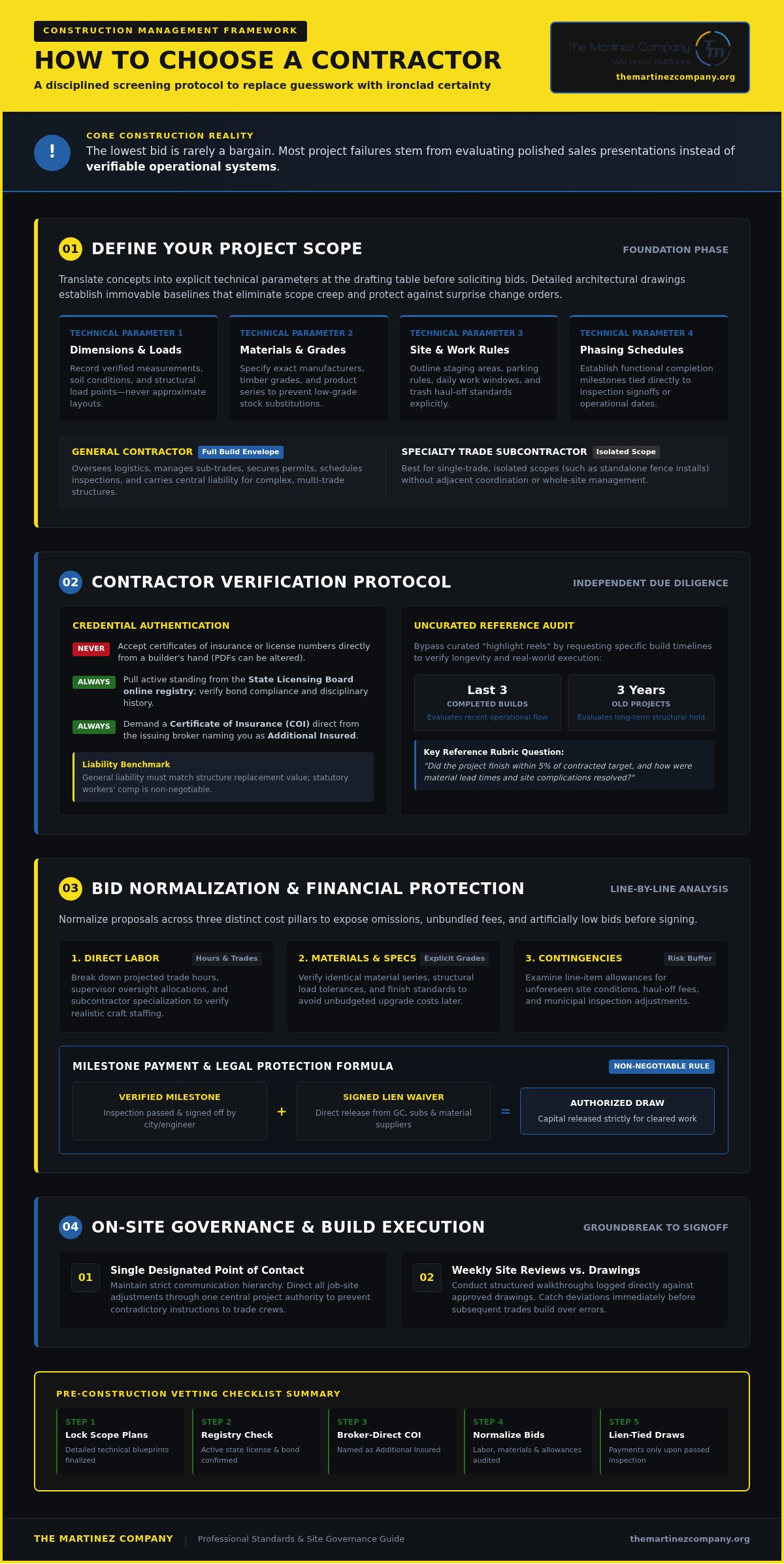
Every failed construction project shares an identical origin point: ambiguous expectations disguised as a plan. Before requesting bids, you must translate concepts into explicit technical parameters. Discovering how to choose a contractor begins long before you contact builders; it starts at your drafting table. Vague design concepts invite guesswork, whereas detailed architectural drawings establish immovable baselines that eliminate scope creep and protect you against surprise change orders.
Shield your capital by dividing project requirements into non-negotiable structural necessities and flexible cosmetic preferences. If you plan a comprehensive residential remodel, an engineered concrete patio, or a commercial build-out, structural integrity comes first. Material specifications must state exact performance ratings, timber grades, and structural load tolerances. Without these explicit standards, prospective builders will inevitably price completely different jobs, leaving you with useless numbers.
Translating Concepts into Technical Specifications
Locking down specifications in writing eliminates costly assumptions. Your bidding package should assemble actionable data points:
Dimensions and load thresholds: Record verified site measurements, soil conditions, and structural load points rather than approximate layouts.
Finish grades and materials: Specify manufacturers, product series, and finish levels to prevent builders from substituting low-grade builder stock.
Site parameters and operational limits: Outline staging areas, parking rules, daily crew work windows, and trash haul-off standards.
Phasing schedules: Establish functional completion dates tied to inspection approvals or business operations.
Distinguishing General Contractors from Specialty Trade Subcontractors
Knowing your scope determines who you hire. A licensed general contractor oversees site logistics, directs sub-trades, secures building permits, and schedules municipal code inspections from groundbreak to completion. They assume overarching liability for the build. In contrast, specialty trade subcontractors focus strictly on their designated trade without managing the site envelope or coordinating adjacent work.
If your project involves isolated work, such as basic fence installation, hiring a specialized trade crew makes sense. Complex builds that integrate commercial spaces, full-scale structural alterations, outdoor living structures, and poured architectural concrete demand cohesive oversight. Understanding how to choose a contractor means knowing when your build's complexity requires a central project authority to guarantee safety, manage inspections, and maintain schedule discipline.
The Contractor Verification Protocol: Licenses, Insurance, and Track Record
Paperwork can easily be staged; independent verification cannot. When learning how to choose a contractor, the first operational rule is simple: never accept certificates of insurance or license numbers directly from a builder's hand. Dishonest operators can alter PDFs or present canceled policies with ease. Always pull current standing straight from your state licensing board's online registry, checking for active classifications, disciplinary actions, and municipal bonding compliance.
Demand that the contractor's insurance broker issue a Certificate of Insurance (COI) sent directly to your inbox. This policy must name you or your property entity as an additional insured party. Verify that general liability limits match the full replacement value of the structure. Insist on statutory workers compensation coverage without exceptions. If an uninsured subcontractor suffers an injury on your site, you bear the financial exposure.
Conducting Thorough Reference Interviews Beyond Curated Lists
Curated reference sheets highlight only the smoothest jobs. Bypass the hand-picked favorites by asking for the contractor's last three completed builds, alongside projects finished three years ago. This shows how structural work holds up over time. Run through an exact evaluation rubric:
Schedule and budget variance: "Did the project cross the finish line within five percent of the contracted target, and how were material lead times managed?"
Problem resolution: "When unforeseen site complications emerged beneath the surface, how did the superintendent document the issue before presenting solutions?"
Site management: "Did crews sweep the site perimeter daily, contain construction debris, and secure access gates every evening?"
Evaluating Trade Specialization and Structural Capability
A builder's job sites reveal their real operational standards. Request a visit to an active build to observe safety gear, material organization, and craftsmanship. Look for demonstrated competency across demanding structural trades, such as precision concrete formwork and complex outdoor living spaces. Builders who coordinate poured concrete, structural framing, and integrated fencing demonstrate broad operational discipline.
Prioritize seasoned organizations with at least a decade of continuous performance. If you want a builder that executes commercial and residential structures under rigorous governance, examine how The Martinez Company structures project transparency from the first site audit. True confidence in how to choose a contractor rests on verified public records, direct broker confirmations, and seeing real craftsmanship in the field.
How to Compare Contractor Bids: Apples-to-Apples Analysis
A bottom-dollar estimate is rarely an act of generosity. When evaluating proposals, an unnaturally low total usually reveals missing scope, substandard materials, or stripped-out labor allowances. Learning how to choose a contractor requires normalizing disparate bids into a single, standardized balance sheet. If one builder prices complete site demolition, daily debris haul-off, and municipal permitting while another omits them entirely, you aren't comparing competing prices. You are comparing two fundamentally different projects.
Demand line-item visibility across every trade division. Structural elements like reinforced concrete, framed assemblies, and outdoor infrastructure must account for identical site protection, material grades, and cleanup protocols. Without uniform line items, comparing totals is meaningless.
Deconstructing Bid Structures and Pricing Methodologies
Contract format dictates where financial risk lands during construction. Evaluate the framework governing each proposal:
Lump-sum fixed price: Establishes a firm, guaranteed cost for a well-defined scope. The builder absorbs minor material shifts, giving you predictable financial planning.
Time-and-materials (cost-plus): Passes real labor hours and wholesale material bills directly to you alongside an agreed management markup. This structure introduces open-ended exposure if weather delays or logistics problems emerge.
Material allowances: Check whether allowances reflect actual commercial or high-end residential specifications. Builders sometimes insert unrealistically low placeholder numbers to artificially deflate upfront costs.
Auditing Exclusions and Hidden Project Costs
The true cost of a build hides in the fine print. Master how to choose a contractor by reading the exclusions page before looking at the bottom line. Watch for critical omissions that inevitably trigger expensive mid-project change orders:
Site preparation and grade alterations: Verify whether proposals include clearing, soil grading, and structural sub-base compaction.
Permitting and regulatory coordination: Clarify who assumes direct operational and financial responsibility for filing plans and managing inspection schedules.
Contingency buffers: Insist on a documented contingency line item for unforeseen structural discoveries behind existing framing or beneath slabs.
Ambiguous standards: Strike out vague phrases like "built to standard industry practices." Every milestone must point to engineered drawings or explicit manufacturer installation manuals.
Contract Anatomy: Milestone Payments, Lien Waivers, and Legal Protection
A construction contract isn't merely an administrative formality. It is your primary instrument of operational governance. Knowing how to choose a contractor means knowing how to protect your capital through enforceable contractual boundaries. Never hand over substantial funds upfront; initial deposits should never exceed ten to fifteen percent prior to mobilization. Large upfront checks strip you of operational leverage before a single piece of equipment arrives on site.
Structure your disbursements around objective physical progress. Tie every financial draw directly to verified benchmarks, such as a cured concrete foundation, structural rough-in completion, or passed municipal code inspections. Never issue payments based on elapsed calendar time. Retain ten percent of the total contract value until the final punch list is signed and full municipal sign-off is documented.
Securing Mechanics Lien Protections and Warranties
Property owners often face legal claims from unpaid trade partners, even after paying the primary builder in full. You must establish an airtight lien protection protocol at every stage of the project:
Preliminary notices: Track every subcontractor, supplier, and equipment rental yard delivering materials to your site from day one.
Progress waivers: Exchange conditional lien waivers for payment checks, followed by signed unconditional lien waivers for previous draws before releasing subsequent funds.
Final releases: Secure final unconditional lien waivers from all trade disciplines before dispersing retained funds.
Craftsmanship warranties: Require explicit written warranties guaranteeing structural work and materials against installation defects for defined operational periods.
Establishing Change Order Governance and Delay Clauses
Uncontrolled changes destroy building timelines and inflate costs. Mandate that any site deviation, structural discovery, or scope alteration stops work on that specific element until costs are calculated in writing. Require mutual signatures on all change orders before crews purchase additional materials or alter building assemblies. Your agreement must clearly define fixed labor rates and allowable contractor markups on modifications.
Differentiate between force majeure delays, like severe weather events, and unexcused schedule lapses. Establish enforceable completion dates with clear remedies for delays within the builder's operational control. If you require disciplined project oversight backed by transparent contracts, consult with our contracting team to execute your next project under institutional standards. Understanding how to choose a contractor requires demanding structural accountability on paper long before work begins in the dirt.
Partnering for Success: Managing the Build from Groundbreak to Signoff
Executing a successful build isn't just about vetting paperwork; it requires disciplined field collaboration. Once dirt moves, chaos follows quickly if site communication lacks structure. Designate a single authorized point of contact for both yourself and the builder before mobilization. When multiple stakeholders or crew leaders issue conflicting directives on site, schedules collapse and costly errors multiply.
Put every verbal conversation on paper. If you discuss finish details, grade elevations, or structural modifications during a site visit, summarize the agreement in writing within twenty-four hours. An unwritten conversation on a noisy jobsite is an invitation for future disputes.
Establishing Communication Channels and Progress Reviews
Field execution must remain strictly tethered to the architectural plans. A professional builder uses structured project controls rather than casual text messages:
Digital progress tracking: Expect regular updates, detailed progress photography, and updated milestone schedules uploaded to a centralized platform.
Scheduled weekly walkthroughs: Walk the site alongside the project superintendent at set intervals, reviewing completed assemblies directly against approved drawings.
Immutable decision logs: Keep a running record of technical inquiries, structural clarifications, and finish selections to maintain accountability.
Conducting the Final Punch List and Closeout Audit
Mastering how to choose a contractor culminates at project closeout. Never disburse the final ten percent retainage until every line item is complete and verified. Walk every linear foot of the property with the lead superintendent, compiling an itemized punch list covering surface finishes, joint alignments, and mechanical clearances.
Demand complete site remediation before final signoff. Crews must haul away temporary staging, clean poured surfaces, and remove all construction debris. Secure all municipal permit inspection cards, equipment manuals, and written manufacturer warranties for your records.
True peace of mind comes from partnering with a builder who treats administrative governance with the same rigor as their physical craftsmanship. Explore how The Martinez Company delivers disciplined operational leadership, exact scheduling, and enduring quality across commercial projects, residential renovations, concrete work, and outdoor living environments. Knowing how to choose a contractor empowers you to manage the entire construction lifecycle with unwavering authority.
Take Command of Your Construction Project with Proven Governance
Selecting the right builder isn't a gamble. It is an operational audit. True project success starts with technical drawings that lock down scope, relies on independent credential checks straight from the source, and stays on track through milestone payments tied to verified inspections. When you master how to choose a contractor with this level of discipline, you eliminate the uncertainty that derails ordinary builds.
Bring your vision from initial blueprints to enduring physical reality. Backed by an established track record delivering commercial and residential structures since 2014, our team upholds uncompromising standards across structural builds, precision concrete, and engineered outdoor living environments. We manage every phase with transparent operational protocols that prioritize accountability, stability, and schedule integrity. Partner with The Martinez Company to execute your next project on an unshakeable foundation.
Frequently Asked Questions
How do I verify if a general contractor is properly licensed and insured?
Verify credentials directly through your state licensing board's official online registry rather than accepting paper certificates. Check for active standing, correct trade classifications, and any unresolved disciplinary records. For insurance, instruct the contractor's independent insurance broker to send a Certificate of Insurance straight to your email. Confirm that general liability coverage matches your property's replacement value and ensure statutory workers compensation is active without exclusions.
What is an acceptable down payment before construction work begins?
An acceptable initial deposit typically ranges between ten and fifteen percent of the total project contract. This initial disbursement funds site mobilization, permit acquisition filings, and procurement scheduling. Never provide massive upfront sums or pay for specialized materials before crews break ground. Reputable builders rely on established operational credit lines to mobilize, structuring all subsequent payments strictly around verified, inspection-approved milestones.
What are the biggest red flags to watch for when choosing a contractor?
The most dangerous red flag is a contractor demanding large cash advances before delivering materials or beginning work. Other critical warnings include lacking verifiable trade licensing, offering verbal estimates without line-item scope breakdowns, and pressuring owners to pull municipal permits. When mastering how to choose a contractor, treat reluctance to provide broker-issued insurance certificates or sign formal lien waivers as an immediate reason to walk away.
How many contractor bids should I collect for a major renovation?
Collect three to four detailed bids from reputable builders who demonstrate proven expertise in your specific project scope. Solicit these estimates using identical architectural drawings and unambiguous material schedules. Gathering fewer than three proposals leaves you vulnerable to skewed pricing, while reviewing more than four introduces administrative confusion. Normalize each submission line by line across labor, material allowances, supervision, and site cleanup protocols.
What is the difference between a fixed-price contract and a cost-plus contract?
A fixed-price agreement establishes a guaranteed lump sum for an explicitly defined scope, placing the financial risk of minor cost variances on the builder. A cost-plus contract charges you actual wholesale material costs and labor hours alongside a pre-agreed contractor management fee. While cost-plus works for exploratory structural renovations, fixed-price contracts provide superior budget certainty for commercial spaces, structural concrete work, and custom outdoor living builds.
What happens if a contractor encounters unexpected problems behind walls or underground?
Work on that specific structural element must halt immediately until crews document and evaluate the hidden condition. A disciplined builder photographs the issue, reviews engineering requirements, and calculates exact labor and material costs before touching the assembly. The superintendent issues a written change order outlining the corrective scope and timeline impact. Never accept verbal authorizations; both parties must sign the change order before work resumes.
Why are lien waivers mandatory before making milestone payments?
Lien waivers protect your title from legal encumbrances filed by unpaid trade subcontractors, material vendors, or equipment suppliers. Even when you pay your general contractor in full, an unpaid supplier can place a mechanics lien on your real estate. Knowing how to choose a contractor means requiring signed conditional lien waivers alongside each progress invoice, followed by unconditional releases once funds clear your bank account.


Comments