
Commercial General Contractor: Roles, Process, and How to Choose
What if the biggest challenge in a commercial build isn’t the work itself, but keeping every decision, trade, and deadline aligned? A commercial general contractor helps coordinate the moving parts, yet owners may still wonder who is responsible when the scope shifts or costs change.
That uncertainty is understandable. A successful project depends on clear communication among the owner, design team, contractor, and trade partners. Expectations need to be established before work begins and tracked through completion. Knowing what the contractor handles, and what remains your responsibility, makes it easier to spot gaps before they cause disruption.
This guide explains a commercial general contractor’s role from early planning through project closeout, outlines how a project can move from defined scope to handover, and shares questions to ask when comparing potential partners. You’ll also see how to assess whether The Martinez Company’s confirmed commercial contracting capabilities fit your needs. Focused on construction and renovation since 2014, the company also offers concrete, fence installation, and outdoor living spaces. Those capabilities may be relevant to certain project scopes. Use the details ahead to evaluate fit, clarify responsibilities, and choose a partner with confidence.
Table of Contents
What a Commercial General Contractor Does, and When to Hire One
How a Commercial General Contractor Moves a Project from Scope to Closeout
Commercial General Contractor Delivery Models and Responsibilities Compared
How to Evaluate a Commercial General Contractor Before Signing
Is The Martinez Company the Right Commercial General Contractor for Your Project?
What a Commercial General Contractor Does, and When to Hire One
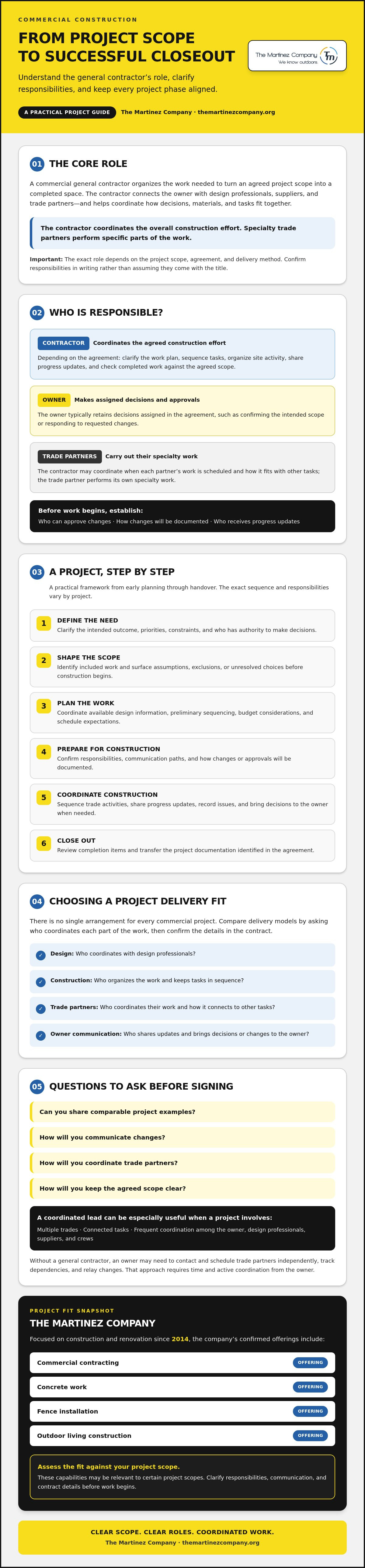
A commercial general contractor organizes the work needed to turn an agreed project scope into a completed space. The contractor connects the owner with design professionals, suppliers, and trade partners, helping coordinate their work so decisions, materials, and tasks move in a workable sequence. The exact role depends on the project scope, agreement, and delivery method.
A general contractor coordinates the overall construction effort, while specialty trade partners perform specific parts of the work. For example, a contractor may coordinate when a trade partner’s work is scheduled and how it fits with other tasks, while that trade partner carries out its own specialty work. The General contractor overview offers additional background on this coordinating role.
Which project responsibilities may the general contractor coordinate?
Depending on the agreement, coordination may include clarifying the work plan, sequencing tasks, organizing activity on site, sharing progress updates, and checking completed work against the agreed scope. These activities help owners understand how tasks connect and where a decision or change could affect the next step. Confirm each responsibility in writing rather than assuming it comes with the title.
The contractor can guide and communicate, but the owner typically retains the decisions and approvals assigned to them in the agreement, such as confirming the intended scope or responding to requested changes. Before work begins, establish who can approve changes, how they’ll be documented, and who receives progress updates.
When does a business benefit from hiring a commercial general contractor?
A coordinated project lead can be especially useful when work involves multiple trades, connected tasks, or frequent coordination among the owner, design professionals, suppliers, and crews. If one activity must be completed before another can proceed, someone needs to keep the sequence visible and communicate adjustments to the people affected.
Without a general contractor, an owner may need to contact and schedule each trade partner independently, track dependencies, and relay changes between participants. That can suit some projects, but it requires time and active coordination from the owner. A commercial general contractor may be a better fit when the owner wants a defined point of coordination, provided the contract clearly states the contractor’s duties and the owner’s decisions.
There’s no single arrangement for every commercial project. Compare the project’s complexity, the coordination it requires, and the time your team can commit. Then match those needs to a clearly documented scope.
How a Commercial General Contractor Moves a Project from Scope to Closeout
A construction project gains direction when its needs are translated into a defined scope, a workable plan, and clear decision-making. A commercial general contractor may help coordinate that progression, but the sequence and responsibilities vary. Scope, contract terms, and delivery method shape each project sequence.
Think of the process as a series of connected steps:
Define the need. Clarify the intended outcome, priorities, constraints, and who has authority to make decisions.
Shape the scope. Identify the work included and surface assumptions, exclusions, or unresolved choices before construction begins.
Plan the work. Coordinate available design information, preliminary sequencing, budget considerations, and schedule expectations.
Prepare for construction. Confirm responsibilities, communication paths, and how changes or approvals will be documented.
Coordinate construction. Sequence trade activities, share progress updates, record issues, and bring decisions to the owner when needed.
Close out. Review completion items and transfer the project documentation identified in the agreement.
This sequence is a practical framework, not a promise that every project follows the same steps. The Associated General Contractors of America provides broader industry resources. For a specific project, the written agreement remains essential for defining each party’s role.
What happens during commercial pre-construction?
Before work starts, the owner and project team can discuss the desired scope, preliminary planning, constructability questions, and budget coordination. Identify decision-makers and rank priorities early. For example, clarify which outcomes are essential and where flexibility may be possible. Estimates and schedules depend on the scope and information available, so record unresolved details rather than treating them as settled assumptions.
What should owners expect during construction and closeout?
During construction, trade sequencing and progress communication help participants understand what is happening and what comes next. If an issue or proposed change arises, document it, clarify its potential effect, and follow the agreed approval process before proceeding. Owners should know which decisions they must make and how those decisions will be tracked.
At closeout, the parties can review remaining completion items and transfer relevant project records. The exact handover materials and who is responsible for providing them depend on the agreement. Confirm those deliverables in writing, along with how outstanding items will be addressed. To assess a potential fit, review commercial contracting capabilities alongside your project’s defined needs.
Commercial General Contractor Delivery Models and Responsibilities Compared
Delivery models describe how design and construction work are arranged, but the label alone doesn’t tell you who will make decisions, coordinate trade partners, or carry specific responsibilities. Use the comparison as a starting point, then check the proposed agreement for the actual scope, working relationships, and accountability.
These are common patterns, not fixed rules. Model names don’t define final scope, risk allocation, or duties. Before comparing bids, map who coordinates design, construction, trade partners, changes, and owner updates. Compare responsibilities side by side, not just the title or price.
How do general contracting and construction management differ?
In a general contracting arrangement, the contractor typically takes responsibility for carrying out the construction scope and coordinating the contracted trade work. Construction management can describe a range of arrangements, from advisory oversight to a role with broader construction responsibility. Contracting relationships and terminology vary. Ask who signs agreements with trade partners, who directs coordination, and who is accountable for each defined task.
When might design-build be considered?
Design-build may be worth considering when an owner values having design and construction coordinated through one delivery arrangement. Priorities such as a clear communication path or closely connected design and construction decisions can inform the choice, but they don’t guarantee a particular outcome. Verify who provides the design scope, how the team is structured, who approves changes, and where contractual accountability sits.
Choose based on the responsibilities your project needs, not the appeal of a label. Have each prospective team explain its role in writing before you compare proposals.
How to Evaluate a Commercial General Contractor Before Signing
Choose a project partner by how clearly they understand the work, communicate responsibilities, and explain their approach, not by a proposal’s headline alone. A commercial general contractor should be able to explain how the proposed scope will be handled and which decisions remain yours.
What questions reveal a contractor’s project fit?
Ask each candidate the same questions so you can compare their answers directly:
Scope: How do you interpret the requested work? Which assumptions, missing details, or exclusions need clarification before the agreement is finalized?
Communication: Who will provide progress updates, document changes, and bring decisions to the owner?
Trade coordination: Who coordinates trade partners, and how are schedule impacts or conflicts communicated?
Relevant experience: Can you share examples of comparable work and references? What makes those examples relevant to this project?
Ask for examples that match the work’s scope and coordination needs, not just its general category. Treat sector or project claims as information to verify: speak with references and confirm what the contractor was responsible for on those projects. Look for specific, consistent answers rather than relying on broad claims of experience.
How can owners compare commercial construction proposals fairly?
First, check whether each proposal describes the same work. A lower figure may reflect a narrower scope or different assumptions, so compare the details line by line:
Included work, exclusions, and any allowances or assumptions.
Schedule expectations and conditions that could affect sequencing.
Items or decisions the owner must provide or approve.
Who coordinates trade partners and communicates progress.
How proposed changes are documented, reviewed, and approved before work proceeds.
Ask candidates to explain differences in writing. This helps reveal whether proposals are genuinely comparable and gives both sides a clearer reference if the scope changes. Review the agreement to confirm decision-making authority and responsibility for each coordination task.
Hiring a coordinator doesn’t have to add confusion. Clear accountability can reduce uncertainty by giving the owner a defined communication path and a record of decisions. Before signing, check applicable licensing, insurance, and code-related requirements with qualified professionals for the project jurisdiction. Requirements can vary, and credentials should be verified rather than assumed.
If you’re assessing fit for a commercial construction scope, review The Martinez Company’s commercial contracting alongside your project requirements.
Is The Martinez Company the Right Commercial General Contractor for Your Project?
Start with the project, not the company name. Define the work you need, the coordination it involves, and the responsibilities you expect a contractor to take on. Then confirm that the contractor’s stated capabilities fit the scope and that the proposed agreement clearly identifies inclusions, exclusions, decision-makers, communication, and next steps.
The Martinez Company may be a potential partner for suitable commercial construction scopes. The company has focused on construction and renovation since 2014, with confirmed offerings in commercial contracting, concrete work, fence installation, and outdoor living construction. These capabilities may align with the work you’re planning, but they don’t establish experience in a particular commercial sector, project delivery method, or additional service. Confirm those details directly.
Which confirmed capabilities may align with a commercial project?
Begin by matching the core construction scope to the company’s commercial contracting offering. If your defined project also calls for concrete, fencing, or outdoor living construction, ask whether those specific elements fit the proposed work. Don’t assume every project needs them, or that an offering confirms a particular scope, method, or capability beyond what’s stated.
The Martinez Company does not offer plumbing, foundation repair, or emergency repairs. If your project depends on any of those services, clarify how that work would be addressed before moving forward. Ask about any project-specific qualifications or documentation you need to verify. Don’t treat unconfirmed credentials or services as established.
What information should you prepare before contacting a contractor?
A clear starting brief helps both sides discuss fit without leaving key assumptions hidden. Gather what you know and flag what still needs a decision:
Project goals: Describe the intended outcome and the work you believe is included.
Site information: Share relevant details about the location and current conditions, along with plans or other project documents you already have.
Timing and constraints: Note your desired timing and known limitations that could affect planning.
Decision-making: Identify the people who will review proposals, approve changes, or make project decisions.
Open questions: List what you need to understand about responsibilities, communication, exclusions, and closeout documentation.
Use the initial discussion to test alignment, not to assume it. Ask whether the company’s confirmed commercial contracting and related capabilities fit your scope, what falls outside that scope, and which details need further review. Then establish responsibilities and next steps in writing before making a commitment.
Discuss your commercial project with The Martinez Company and share the scope you’re considering to begin a direct conversation about fit.
Move Your Commercial Project Forward with a Clear Plan
The right commercial general contractor helps bring clarity to the work ahead by coordinating the agreed scope, communicating responsibilities, and keeping decisions documented. Before signing, compare proposals for what’s included, how changes are handled, and who is accountable for each part of the process. A clear agreement gives owners and project partners a stronger foundation for moving from plans to completion.
The Martinez Company has focused on construction and renovation since 2014. Its confirmed capabilities include commercial contracting, concrete, fencing, and outdoor living construction. Whether those services fit depends on your project’s specific scope, priorities, and requirements, so confirm responsibilities, exclusions, and next steps directly.
Prepare your project goals and known constraints, then discuss your commercial project with The Martinez Company. A thoughtful first conversation can help you assess fit and take the next step with confidence.
Frequently Asked Questions
What does a commercial general contractor do?
A commercial general contractor coordinates agreed construction work, communicates with the owner, and helps organize trade partners and the sequence of tasks. The exact role depends on the project’s delivery method and written agreement. Before hiring, ask which activities the contractor manages, what decisions you’ll make, how proposed changes are recorded and approved, and which project records or closeout items are included. Clear answers help establish expectations before work begins.
When should a business hire a commercial general contractor?
Consider hiring one when a project includes multiple trade partners, connected tasks, or coordination your team can’t readily manage alongside its other responsibilities. The best arrangement depends on the scope, desired timing, internal resources, and contract structure. First list the coordination work you need handled. Then ask prospective contractors how they would address it, what they would expect from your team, and which responsibilities would remain with you.
What is the difference between a general contractor and a construction manager?
The distinction depends on the project arrangement and agreement, so the titles alone aren’t enough to compare roles. A general contractor commonly coordinates construction work within an agreed scope, while a construction manager’s role may range from advice and oversight to broader coordination. Ask each candidate who contracts with trade partners, who directs their work, who reports to the owner, and who is accountable for each task. Request the answers in writing.
How do I compare commercial general contractor proposals?
Compare each proposal against the same project requirements, not just the total or summary page. Check included work, exclusions, assumptions, schedule expectations, owner-provided items, and responsibilities. If a proposal uses an allowance or leaves a detail open, ask what it covers and what information could change it. Clarify how changes are documented and approved before work proceeds. Resolve unclear items before choosing so you understand what each offer actually addresses.
What should I ask a commercial general contractor before hiring?
Ask the contractor to explain how they understand your scope and identify unresolved assumptions. Confirm who will coordinate trade partners, communicate progress, document proposed changes, and seek your approval. Request relevant project examples and references, then verify that their responsibilities and work are comparable to your needs. Ask what information they need from you to assess fit. Check applicable insurance, licensing, and project requirements through qualified sources for your project.
Does a commercial general contractor handle every part of a project?
No. A contractor’s responsibilities depend on the agreed scope, delivery method, and contract. Design professionals, specialty trade partners, the owner, or other consultants may handle parts of the work or decision-making. Before signing, ask for a written breakdown of what’s included and excluded, who approves decisions, and how additional or unresolved work will be addressed. A clear division of responsibilities helps prevent assumptions from becoming disputes during the project.
What information should I have ready before contacting a commercial contractor?
Prepare a concise description of the project, the outcome you want, available site information, an approximate scope, your preferred timing, and known constraints. Identify who will make decisions and note questions about responsibilities, approvals, or project records. You don’t need every detail finalized. Separate confirmed information from open questions so the contractor can discuss what’s understood, what needs clarification, and what the next useful step might be.


Comments