
2026 Guide to Outdoor Kitchen Concrete Countertops
Can a countertop really survive a decade of brutal freeze-thaw cycles and scorching summer heat while remaining the most striking feature of your home? Most materials fail under the pressure of the elements. You deserve a workspace that matches the rugged demands of the outdoors without sacrificing the polished elegance of a high-end interior. Choosing concrete countertops for outdoor kitchens is about more than just pouring a slab; it is an exercise in structural engineering and artisanal craft.
You likely worry about the weight of the material on your patio or the risk of staining during a summer cookout. We understand those concerns because we prioritize stability and perfection in every build. This guide will show you how to transform your backyard into a durable sanctuary using advanced Glass Fiber Reinforced Concrete and professional-grade sealants. We will cover everything from weight distribution to integrated features like custom drainboards, giving you the clarity needed to build for permanence and increase your property value through high-end design. It is time to move from abstract ideas to a completed physical result that stands the test of time.
Table of Contents
Why Concrete Countertops are the Standard for Modern Outdoor Kitchens
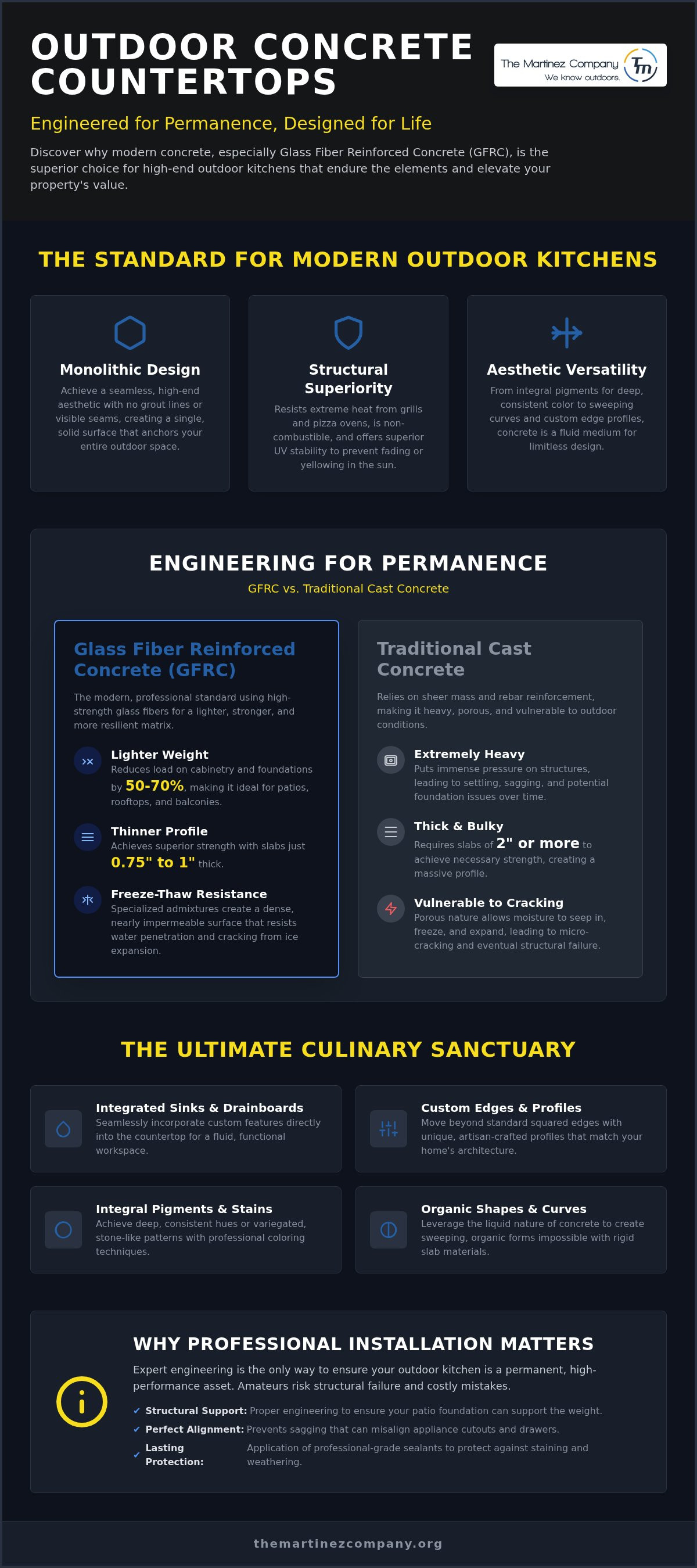
Custom-engineered concrete countertops for outdoor kitchens represent the pinnacle of architectural functionality. Unlike mass-produced slabs, these surfaces are tailored to your specific culinary workflow, transforming a simple patio into a professional-grade sanctuary. We don't view concrete as a basic building material; we treat it as a fluid medium that achieves a monolithic presence that stone or tile cannot match. It is the transition from a concept of "outdoor cooking" to a physical reality of a high-end culinary station.
Traditional tile or stone installations rely on grout lines and visible seams that break the visual flow of your workspace. In contrast, concrete offers a seamless expanse that anchors the entire design. While synthetic solid surfaces often rely on plastic resins, Concrete Countertops provide a natural, mineral-based alternative that thrives in the open air. This material is an aspirational choice for homeowners who value permanence and high-level craftsmanship over temporary trends. It signals a commitment to quality that lasts for decades.
The Aesthetic Advantage: Beyond the Industrial Look
Modern concrete is a canvas for color and texture. We use integral pigments to saturate the mix with deep, consistent hues, or apply acid stains to create variegated patterns that mimic the movement of natural stone. Because concrete begins as a liquid, it allows for organic, sweeping curves and custom edge profiles that are impossible to achieve with rigid materials. A professionally polished surface offers a tactile experience that is smooth to the touch yet retains a rugged, earthy character. It feels substantial under your hands. It looks intentional in its design. This versatility ensures the final result complements your home's architecture perfectly.
Structural Superiority in Outdoor Environments
Outdoor cooking involves extreme temperature shifts. High-heat appliances like wood-fired pizza ovens and industrial grills can reach temperatures that would melt the resins in quartz or crack thin porcelain. Concrete remains unfazed. It offers superior UV stability, meaning your concrete countertops for outdoor kitchens won't yellow or fade under the constant glare of the sun. Unlike resin-based synthetics, concrete is a non-combustible material that provides an essential layer of fire safety for your outdoor living space. It is built to endure the elements while maintaining its structural integrity and aesthetic finality. You aren't just installing a surface; you're engineering a permanent asset.
Engineering for Permanence: GFRC vs. Traditional Cast
The evolution of concrete countertops for outdoor kitchens has moved past the heavy, cumbersome slabs of the past. Today, Glass Fiber Reinforced Concrete (GFRC) stands as the professional industry standard. While traditional wet-cast methods rely on sheer mass, GFRC uses high-strength glass fibers to create a matrix that is thinner, lighter, and significantly more resilient. This engineering shift allows us to cast slabs at 0.75 to 1 inch thicknesses that consistently outperform 2-inch traditional pours in both strength and durability.
Freeze-thaw cycles present the greatest threat to outdoor masonry. Traditional concrete is naturally porous. It allows moisture to seep into the internal structure where it expands as it freezes, inevitably leading to micro-cracking and eventual structural failure. High-performance GFRC utilizes specialized admixtures and acrylic polymers to drastically increase density. This creates a nearly impermeable surface that resists water penetration and protects against the deep-set staining common in active culinary environments. It is a surface built for the transition from a concept to a permanent physical result.
Weight Management and Structural Support
Standard concrete is incredibly heavy. A traditional 2-inch thick slab can put immense pressure on your outdoor cabinetry and patio foundation, leading to settling issues. Engineering your project with GFRC reduces this load by 50% to 70% compared to traditional precast. This weight reduction prevents the sagging or shifting of the kitchen island over time, ensuring your appliance cutouts and drawers remain perfectly aligned. For rooftop or balcony installations, this lighter profile is often the only viable way to achieve a high-end stone look without exceeding structural floor load limits. Choosing the right material ensures stability and perfection in every build.
Reinforcement Strategies: Rebar vs. Fiber
Longevity depends on how a slab handles tension. Traditional rebar provides primary reinforcement but can be problematic in thin outdoor slabs. If moisture reaches the steel, it rusts and expands, causing the surrounding concrete to "spall" or flake away. GFRC replaces this with millions of alkali-resistant glass fibers distributed throughout the entire mix. This provides superior tensile strength and impact resistance. It holds the slab together from the inside out, preventing the catastrophic cracks that often plague DIY projects. You get a surface that is as tough as it is beautiful.
Customization Options for the Ultimate Culinary Sanctuary
Design should never be limited by the material. When planning concrete countertops for outdoor kitchens, the only real constraint is your imagination. Because concrete begins as a fluid, it offers a level of customization that rigid stone slabs simply cannot provide. We don't just pour surfaces; we engineer architectural elements that reflect your specific lifestyle and culinary needs. Our role as a Reliable Visionary is to bridge the gap between your abstract goals and a permanent, high-end installation that anchors your entire outdoor living space.
The transition from a basic patio to a sophisticated culinary sanctuary requires a focus on how you actually use the space. We look at the workflow of the chef. We consider the movement of guests. Every curve, cutout, and feature is intentional. This meticulous approach ensures that your kitchen isn't just a collection of appliances, but a cohesive, functional structure designed for the realization of your entertaining goals.
Integrated Features and Functional Design
Functionality is the heart of a high-end outdoor kitchen. One of the most significant advantages of custom concrete is the ability to cast features directly into the pour. Sloped, integrated drainboards are a prime example. They allow water to flow naturally back into the sink, making cleanup effortless after a large gathering. We can also cast custom voids for specialized needs, such as:
Built-in herb planters located right next to the prep station.
Integrated ice chests or wine chillers for seamless entertaining.
Custom trash chutes that keep the workspace clean and uncluttered.
Sinks can be integrated as well. You can choose between the sleek look of an under-mount sink or a fully integrated concrete basin cast as a single, seamless piece with the countertop. This eliminates the gaps where debris often collects in traditional installations.
Edge Profiles and Surface Textures
The final aesthetic of your concrete countertops for outdoor kitchens is defined by the details of the finish. Edge profiles can range from sharp, minimalist square edges to "chiseled" stone textures that provide a rugged, organic feel. For those seeking a truly unique look, we can incorporate decorative inlays. Recycled glass, glow-in-the-dark aggregates, or polished river stones can be seeded into the surface to create a one-of-a-kind mosaic. The surface texture itself is equally versatile. You might prefer a matte, honed finish for a modern industrial vibe, or a high-gloss reflective surface that mimics the depth of polished granite. Each choice is a step toward aesthetic finality and a project built to last.
The Maintenance Protocol: Protecting Your Investment
Staining and porosity remain the primary concerns for homeowners considering concrete countertops for outdoor kitchens. These fears are often fueled by poorly executed DIY projects or low-grade installations that lack a professional finishing strategy. We treat maintenance as a rigorous protocol rather than an afterthought. A properly engineered surface isn't just a slab of stone; it is a high-performance architectural element designed to withstand oil, wine, and the elements. We prioritize aesthetic finality by ensuring the protection layer is as robust as the structural core.
Understanding the difference between a natural patina and actual damage is the first step in successful ownership. Concrete is an artisanal material that evolves over time. A "patina" is the subtle deepening of color and texture that occurs through use, adding character to your outdoor sanctuary. Damage, conversely, is the result of structural neglect or sealer failure. Our goal is to provide a surface that ages gracefully while remaining impervious to deep-set contaminants. This transition from a brand-new installation to a seasoned culinary workspace is part of the material's unique appeal.
Choosing the Right Sealer: Topical vs. Penetrating
The choice of sealer defines the longevity of your investment. Penetrating densifiers work at a molecular level to fuse with the concrete matrix, closing off the internal pores to prevent water and oil absorption from the inside out. This creates a permanent internal shield. Topical sealers, such as high-performance urethanes, provide a sacrificial barrier on the surface. These are excellent for resisting scratches and high-heat exposure from grills or pizza ovens. While no sealer is entirely "bulletproof," a professional application ensures the highest level of protection possible. You deserve the security that comes from stability and perfection in your finish.
Seasonal Care and Repair Strategies
Annual maintenance is straightforward but essential. In regions with harsh winter freeze-thaw cycles, we recommend covering your countertops during the off-season to prevent standing water from sitting on the sealer for extended periods. Daily cleaning requires nothing more than mild soap and water. Avoid harsh acidic cleaners that can etch the surface over time. If you notice "hairline" cracks, don't worry. These are often superficial and don't affect the structural integrity of the GFRC. However, if water stops beading on the surface, it is a clear signal that a professional re-seal is necessary. Most outdoor environments require a fresh application every 1 to 3 years to maintain peak performance and visual depth.
Executing the Build: Why Professional Installation Matters
Realizing a high-end vision requires more than just high-quality materials. It demands the rugged confidence of a general contractor who understands the logistical weight and structural requirements of the project. While some sources suggest that concrete countertops for outdoor kitchens are a simple weekend project, the reality involves complex engineering and precise execution. Transporting and setting large-scale concrete slabs is a high-stakes operation. One wrong move during the transition from the casting table to the outdoor island can result in catastrophic fractures or surface blemishes that ruin the aesthetic finality of the piece.
Since 2014, we've focused on the "how" of the build as much as the "what." A professional installation ensures that your culinary sanctuary is built to last, with every joint and edge meeting our standard of stability and perfection. We coordinate the entire process, ensuring the concrete integrates seamlessly with your appliances and the underlying structure. This methodical approach saves time and prevents the expensive errors common in unmanaged builds.
The Precision of Professional Templating
Accuracy is the foundation of every successful installation. We use digital or physical templating to create an exact blueprint of your kitchen layout before a single drop of concrete is poured. This precision is critical for a perfect fit around high-end grills, side burners, and power burners. Even a quarter-inch deviation can prevent an appliance from seating correctly. Beyond appliance fit, we calculate the necessary reinforcement for bar seating overhangs. A 10 to 12 inch overhang provides a comfortable workspace but requires specific internal engineering to prevent snapping under pressure. We also account for the natural slope of your patio. While your floor must drain water, your workspace must be perfectly level for cooking, a balance achieved through expert shimming and structural grouting.
Integrating with Fences and Outdoor Structures
We view your project through the lens of a master plan. A countertop shouldn't exist in isolation; it should complement the entire backyard sanctuary. There is a powerful design synergy between the cool, architectural lines of gray concrete and the warm, organic grain of custom cedar fencing. As experts in both Outdoor Living Spaces and Fence Installation, we ensure the kitchen layout respects the flow of your property and the placement of your boundaries. This holistic perspective transforms a simple renovation into a complete lifestyle upgrade. Transform your outdoor living space with the experts at The Martinez Company.
Building Your Permanent Outdoor Sanctuary
Choosing concrete countertops for outdoor kitchens is a decision to invest in architectural permanence and bespoke design. You've seen how GFRC technology provides a lighter, stronger alternative to traditional pours; you also understand how professional sealing protocols protect that beauty against the elements. These surfaces aren't just workspaces. They are the anchors of a complete outdoor living sanctuary. Achieving this level of aesthetic finality requires a partner who values structural integrity as much as the final polish.
The Martinez Company has served as a specialist in high-performance concrete since 2014. We provide comprehensive construction management to ensure every project meets our standard of stability and perfection. We handle the logistical complexity and the technical engineering so you can focus on the excitement of your finished space. It's time to move from the planning phase to the physical realization of your goals. Start your outdoor kitchen transformation with The Martinez Company today. Your vision for a high-end culinary retreat is within reach and ready to be built for a lifetime of use.
Common Questions About Outdoor Concrete Countertops
Do concrete countertops crack in cold weather?
Concrete can crack if moisture enters the pores and expands during freezing. We prevent this by using GFRC, which has a higher density and specialized polymers to resist water penetration. Professional-grade sealers also act as a vital barrier for concrete countertops for outdoor kitchens. While minor hairline cracks might appear as the material settles, they don't compromise the structural integrity. Proper engineering ensures your surface survives the harshest national winter cycles without catastrophic failure.
How much do concrete countertops for outdoor kitchens cost compared to granite?
High-end concrete surfaces are often comparable to or slightly more expensive than premium granite. This is because concrete is a custom-engineered architectural element rather than a mass-produced slab. The cost reflects the specialized labor required for templating, casting, and hand-finishing. While granite is limited to what's in the quarry, concrete offers limitless customization. You're investing in a one-of-a-kind structure tailored to your specific culinary workflow and property design.
Can I put hot pots and pans directly on a concrete countertop?
Concrete itself is exceptionally heat resistant and won't melt or catch fire. However, the sealer applied to the surface can be damaged by extreme heat from a pot straight off the grill. High temperatures can cause certain sealers to discolor or delaminate, leaving the concrete vulnerable to stains. We always recommend using trivets or hot pads. This simple habit protects the aesthetic finality of your workspace and ensures the protective barrier remains intact.
Are concrete countertops too heavy for a standard outdoor kitchen frame?
Traditional cast concrete can weigh as much as 25 pounds per square foot, which often requires reinforced cabinetry. We solve this by using GFRC, which allows for thinner slabs that are significantly lighter than traditional precast. Most professional outdoor kitchen frames can support these lighter slabs without additional structural modifications. We always verify the load-bearing capacity of your specific island structure during the design phase to ensure long-term stability and perfection.
How often do I need to seal my outdoor concrete countertops?
Most outdoor installations require a fresh sealer application every one to three years. The exact timing depends on your local climate and how much direct sun the surface receives. You can perform a simple water bead test to check the sealer's integrity. If water no longer beads on the surface and begins to soak in, it's time for a re-seal. Regular maintenance is a straightforward protocol that keeps your investment looking pristine for decades.
Do concrete countertops stain from acidic foods like lemons or wine?
Unsealed concrete is highly porous and will stain quickly when exposed to acids like lemon juice or red wine. However, a professionally applied high-performance sealer creates a barrier that resists these substances. You should still wipe up spills promptly to avoid long-term etching. Over time, your concrete countertops for outdoor kitchens might develop a natural patina that adds character. This evolution is a hallmark of artisanal materials and distinguishes your kitchen from synthetic alternatives.
Can I customize the color of my concrete to match my home’s exterior?
Yes, the color possibilities are virtually limitless. We use integral pigments that are mixed directly into the concrete to ensure the color goes all the way through the slab. We can also apply acid stains to create variegated, stone-like textures that complement your home's siding or stone accents. This ability to match existing architectural elements is why custom concrete is the premier choice for high-end design. It ensures your outdoor sanctuary feels like an intentional extension of your home.
How long does the installation process take for a custom outdoor kitchen?
A custom installation typically takes several weeks from the initial templating to the final setting. Once we create the templates, the slabs are cast and must cure in a controlled environment to reach their full strength. This curing process is essential for structural integrity and aesthetic finality. The actual on-site installation of the finished slabs usually happens in a single day. We manage the entire timeline to ensure the transition from concept to completion is efficient and professional.


Comments