
The Professional Protocol for Choosing a Concrete Contractor in 2026
- estrellahernandezt9
- 2 days ago
- 12 min read
A concrete slab is not a cosmetic finish; it is a meticulously engineered structure that dictates the longevity of everything built above it. Many property owners focus on the surface texture while ignoring the critical subgrade preparation that prevents catastrophic failure. Choosing a concrete contractor in 2026 requires looking past the lowest bid to find a partner who understands that permanence is non-negotiable. With the U.S. concrete market reaching $110.1 billion this year, the gap between expert craftsmanship and cut-rate labor has never been wider.
It's natural to feel uneasy when faced with fluctuating quotes and vague technical promises. You want the security of a build that won't crack under pressure, yet the complexity of shifting regulations and material costs often creates more confusion than clarity. This article provides the professional protocol for your selection process to ensure structural integrity and aesthetic excellence. We will examine the vital 2026 standards, the necessity of precise sub-surface work, and the specific markers of high-level craftsmanship that define a successful build. Master these steps to transform your vision into a physical reality that lasts for generations.
Table of Contents
Why Selecting a Concrete Specialist is a Lifetime Decision
Concrete is a permanent decision. It's the only building material that grows stronger over time but offers zero margin for error during the installation phase. When you're choosing a concrete contractor, you aren't just hiring someone to pour liquid stone; you're selecting an engineer of permanence. Unlike a poorly painted wall or a misaligned fence, a failed concrete pour cannot be easily undone. Once the chemical reaction finishes and the mixture cures, it becomes a literal part of the earth, making any mistake a permanent feature of your property.
The true ROI of high-end concrete work lies in its structural finality. A cheap pour might look acceptable for six months, but the cost of removal and replacement is staggering. You'll pay for the heavy demolition, the haul-away fees, and the entire second installation. A professional approach avoids this cycle by ensuring the site is prepared for the next fifty years, not just the next two. We operate as the "Reliable Visionary," visualizing the precise interaction between the soil, the steel, and the mix before a single shovel hits the dirt. This foresight requires a deep understanding of concrete chemistry and site physics that only a specialist can provide.
The Cost of the "Cheap" Pour
Low-bid contractors frequently cut corners where you can't see them. They use thin slabs, skip vapor barriers, or ignore the necessity of steel reinforcement to save on material costs. Poor drainage planning is the most common culprit behind catastrophic cracking. Within 24 months, a slab without proper water management will shift, settle, and eventually split. Living with a failed construction project takes a heavy psychological toll. Every crack is a reminder of a shortcut taken, turning what should've been a source of pride into a structural eyesore that devalues your home.
Concrete as the Foundation of Outdoor Living
Your patio is more than a simple slab; it's the floor of your outdoor sanctuary. It must support the weight of your life, from custom outdoor kitchens to heavy timber pergolas. These structures require specific load-bearing calculations to prevent the concrete from sinking or shearing under the pressure. Choosing a concrete contractor who understands these engineering requirements ensures your investment remains stable as the seasons change. We focus on the "how" of the build, ensuring every square inch is meticulously prepared to handle the specific demands of your design. Structural concrete is the literal backbone of property value.
Evaluating Structural Integrity: What Happens Below the Surface
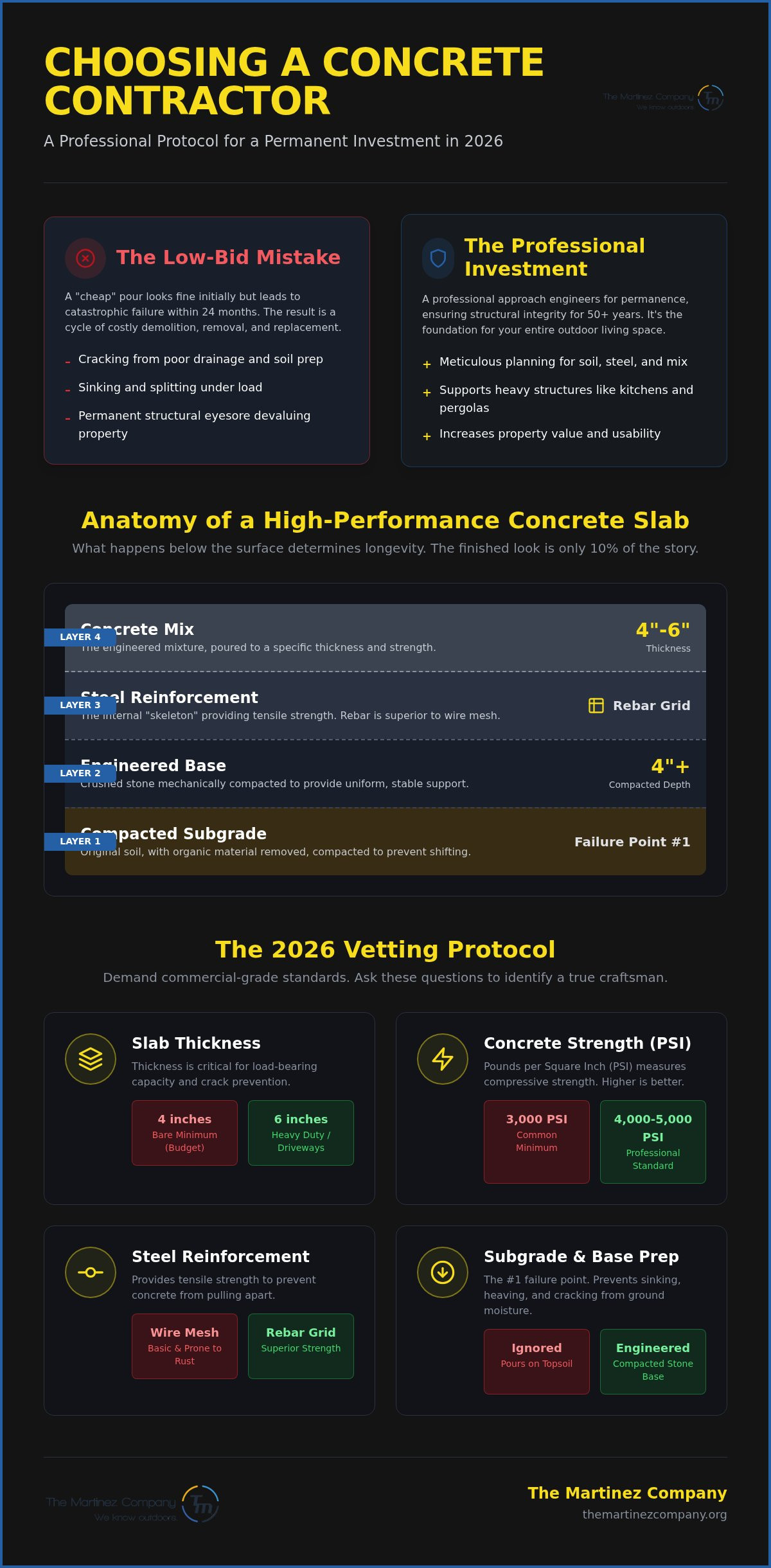
High-end concrete is a multi-layered engineering feat. The finished surface is simply the final act of a long, technical performance. When you are choosing a concrete contractor, your focus must remain on the hierarchy of the pour: subgrade, base, reinforcement, and the mix design itself. If a contractor cannot explain their plan for each of these stages, they aren't building for permanence. They are simply pouring a temporary solution that will eventually fail.
Subgrade and Base Engineering
Subgrade compaction is the number one failure point in the industry. Soil is naturally inconsistent. It expands and contracts with moisture, which can snap a slab in half if the ground isn't properly prepared. A professional begins by removing organic topsoil and replacing it with engineered fill or crushed stone. This base must be mechanically compacted to a specific density to provide uniform support across the entire footprint. We also evaluate the need for vapor barriers, which are crucial in preventing moisture from wicking into the concrete and causing internal degradation. This level of site prep is a non-negotiable standard for anyone serious about vetting contractors for a major investment.
Reinforcement and Mix Design
The internal skeleton of the slab determines its ability to handle tension. While wire mesh is common in budget work, we prioritize rebar for its superior structural integrity and longevity. The grade of the steel and the precision of the spacing are calculated to meet the specific load requirements of the project. This engineering extends to the mix design, where we focus on the following factors:
PSI Requirements: While 3,000 PSI is a common minimum, high-end residential and commercial projects often demand 4,000 to 5,000 PSI for maximum durability.
Air Entrainment: These microscopic bubbles are essential for freeze-thaw durability, preventing the surface from scaling or popping during winter months.
The Slump Test: This on-site test measures the consistency of the wet concrete. It ensures the water-to-cement ratio hasn't been compromised, which would drastically weaken the final structure.
Selecting the right materials is the core of choosing a concrete contractor who values structural perfection. Every additive and every piece of steel serves a purpose in the transition from a liquid state to a permanent physical structure. If you value the "how" of the build as much as the "what," explore our residential and commercial contracting capabilities to see how we execute these standards with precision.
Commercial Standards vs. Residential Execution
Standard residential work often stops at the bare minimum. Most builders follow a "four-inch and finish" rule that fails to account for the actual stresses of modern property use. When you're choosing a concrete contractor, you must look for a partner who bridges the gap between basic home improvement and industrial engineering. We apply commercial-grade specifications to every residential project we touch. This philosophy ensures that your home benefits from the same stability found in high-traffic commercial zones, moving your project from a temporary surface to a permanent asset.
The difference is often found in the thickness and the specific preparation of the site. A standard 4-inch slab is sufficient for a simple sidewalk, but a modern driveway facing heavy SUVs and daily delivery trucks requires a 6-inch heavy-duty pour. By increasing the structural mass and reinforcing the base with commercial techniques, we eliminate the risk of the shifting and "alligator cracking" seen on budget driveways. We believe the family home deserves the same industrial stability as a warehouse floor.
Durability Benchmarks for High-Traffic Areas
Commercial standards dictate a more rigorous approach to joint spacing and sealing. We utilize commercial-grade control joints to manage the natural movement of the slab, ensuring that any settling occurs along pre-determined lines rather than across your visual field. High-performance sealants are equally vital. These industrial-strength barriers protect the concrete from chemical intrusion and moisture, preserving the structural integrity for years. Choosing a concrete contractor who understands these benchmarks is the difference between a project that lasts five years and one that lasts fifty.
Precision and Perfection in Decorative Concrete
Decorative work demands a higher level of technical skill than standard gray slabs. It requires an obsession with levelness and consistency, especially when creating expansive outdoor living spaces. We view the slab as a foundational element that must integrate seamlessly with other high-end features, such as custom cedar fencing or outdoor kitchens. This holistic execution ensures that the aesthetic beauty of the project is supported by the rugged durability of a commercial build. Every edge is crisp, every surface is uniform, and the final result reflects a standard of craftsmanship that most residential contractors simply cannot reach. We don't just pour concrete; we realize a vision of structural perfection.
The 2026 Vetting Protocol: Beyond the Quote
Choosing a concrete contractor in 2026 is an exercise in risk mitigation. A low bid is often a siren song leading to structural failure. You must look past the bottom line to evaluate the systems, standards, and stability of the firm you hire. True professionals don't hide behind vague estimates. They provide granular engineering specs and prove their history through projects that have survived the test of time. This protocol ensures your investment is protected by more than just a handshake.
Portfolio verification is your first line of defense. Don't settle for photos of "fresh" pours; fresh concrete hides every sin. Demand to see projects that are at least five years old. You want to observe how the control joints have held up and whether the surface shows signs of scaling or settlement. Next, conduct a technical interview. Ask specifically about their subgrade compaction process and the PSI of their standard mix. If they can't discuss air entrainment or rebar spacing with precision, they aren't the experts you need for a permanent build.
Administrative vetting is equally critical. Ensure the contractor carries substantial General Liability and Workers’ Compensation insurance. In 2026, modern standards in leading markets have seen contractor license bonds increase to $25,000 to protect consumers. Verify these documents directly with the carriers. Finally, get every engineering specification in writing. Your contract should detail the slab thickness, the reinforcement grade, and the specific drainage plan to ensure there is no ambiguity once the trucks arrive.
The Red Flags of Amateur Contracting
Beware of the "available tomorrow" contractor. High-quality firms usually have a backlog because their work is in demand. A sudden opening is often a sign of a canceled project or a lack of standing in the community. Watch for "truck and a trowel" operations that suggest skipping permits or offer deep discounts for cash payments. These shortcuts strip you of legal protections and often signal a lack of specialized bonding. If they aren't willing to follow the law, they won't follow your engineering specs.
Essential Questions for the Initial Consultation
Ask if they own their heavy equipment or if they rely entirely on rentals. Ownership demonstrates a level of capital investment and commitment to the craft. Query them on their knowledge of the June 2026 updates to construction standards regarding reinforcing steel and training documentation. Contractor reliability is the intersection of a decade-plus founding date and a portfolio that proves structural survival. If you are ready to partner with a firm that values these rigorous standards, contact us to discuss our professional concrete contracting services.
Realizing the Vision: Concrete as a Design Element
Concrete is the ultimate bridge between imagination and reality. It starts as a fluid concept and ends as an immovable, permanent structure that defines your property's character. When you're choosing a concrete contractor, you're looking for someone who can manage the complex engineering while respecting your aesthetic goals. We specialize in this transition, ensuring that every pour serves as a sophisticated design element rather than a mere utility. By integrating structural concrete with high-end outdoor kitchens and entertainment areas, we create a cohesive environment that feels both rugged and refined.
The Martinez Company has focused on stability and perfection since 2014. We understand that your vision requires a contractor who sees the finished result before the first yard of concrete leaves the truck. This foresight allows us to plan for the "how" of the build, ensuring every edge, texture, and color choice aligns with your broader architectural theme. We treat the slab as the literal foundation of your outdoor sanctuary.
The Aesthetic Potential of Modern Concrete
Modern concrete offers a versatile palette of textures and finishes that complement any outdoor living space. From sleek, polished surfaces to intricate stamped patterns, the material can be tailored to match the specific tone of your home. We often see concrete transition seamlessly into custom cedar fencing or heavy timber structures, creating a layered look that combines industrial strength with natural warmth. Our "action-first" rhythm ensures this process moves efficiently from the initial consultation to final mobilization. We value your time and prioritize a logical progression that keeps the project on schedule without compromising on the meticulousness of the finish.
Partnering with The Martinez Company
Choosing a concrete contractor is about more than just finding a laborer. It's about finding a partner who treats your residential project with the same technical precision required for a commercial build. We are specialists in both residential and commercial precision, bringing a decade of experience to every job site. Our goal is to provide a sense of security through reliability while fueling your excitement for the finished transformation. Every project is built to last, emphasizing structural finality as a core value.
If you are ready to move from abstract ideas to a completed physical result, we are prepared to execute your plan. Elevate your project with The Martinez Company by scheduling a comprehensive consultation today. Let's build something that stands for generations.
Building for the Next Generation
Concrete is final. There are no second chances once the mix cures and becomes a permanent part of your property. By prioritizing subgrade engineering and commercial-grade standards, you move beyond the temporary fixes offered by budget-cutting amateurs. Your focus on technical benchmarks like PSI and reinforcement ensures that your outdoor sanctuary remains stable through every season. Choosing a concrete contractor is the most critical decision in your project's lifecycle, as it dictates the structural legacy you leave behind.
The Martinez Company has delivered this level of stability and perfection since 2014. We are specialists in both commercial and residential concrete, bringing industrial-strength expertise to every family home and integrated outdoor living space we build. We don't just pour slabs; we realize visions through meticulous craftsmanship and unyielding integrity. It's time to transform your abstract ideas into a physical reality that stands for decades.
Secure your structural legacy with The Martinez Company. Your property deserves the confidence of a build that is engineered to last. We are ready to get to work on your future.
Frequently Asked Questions
How much does a professional concrete contractor typically charge per square foot?
Industry averages for 2026 suggest a standard 4-inch residential slab installed costs between $6 and $12 per square foot. This figure typically covers labor, materials, and finishing, but it excludes demolition or permit fees. Prices vary based on site accessibility and the complexity of the reinforcement. While material costs for ready-mix concrete average $155 per cubic yard, the final quote reflects the engineering required for structural permanence.
Is a permit required for a new concrete driveway or patio installation?
Most local municipalities require a permit for any project that alters the footprint of impermeable surfaces on your property. This includes new driveways, expansive patios, and structural slabs for outdoor kitchens. Your professional contractor should handle the application process to ensure compliance with zoning laws and drainage regulations. Building without a permit risks fines or the forced removal of the structure, which is a costly mistake to avoid.
How can I tell if my concrete contractor is using the correct PSI mix?
You can verify the mix design by requesting the delivery ticket from the ready-mix truck driver. This document lists the exact PSI rating, water content, and any additives like air entrainment for the specific load. A professional contractor will review this ticket before the pour begins to ensure it matches the engineering specifications in your contract. Monitoring the slump test on-site provides additional confirmation of the final structural strength.
What is the difference between cement and concrete when hiring a professional?
Cement is the binding agent, while concrete is the finished structural composite. When you are choosing a concrete contractor, it's vital to understand that cement is just one ingredient in the mix, alongside water, sand, and stone aggregate. The contractor's skill lies in balancing these elements to create a durable slab. Think of cement as the glue and concrete as the engineered result that supports your home's infrastructure.
How long should I wait before driving on a newly poured concrete driveway?
You should wait at least seven days before driving a standard passenger vehicle on a newly poured driveway. While the surface feels hard within 24 hours, the internal chemical reaction takes time to reach structural capacity. Heavy delivery trucks or large SUVs should stay off the surface for a full 28 days. This duration allows the concrete to achieve its maximum PSI, preventing premature cracking or surface indentations.
Can a concrete contractor also handle my fence and outdoor kitchen installation?
High-end firms like The Martinez Company specialize in integrated outdoor living transformations. We handle the structural concrete foundation while simultaneously managing custom fence installation and outdoor kitchen builds. This holistic approach ensures that the load-bearing requirements for heavy masonry or pergolas are calculated into the initial pour. Partnering with a single expert for these components creates a seamless transition from abstract design to a completed physical sanctuary.
What should be included in a standard concrete construction contract?
A professional contract must include precise engineering specifications such as slab thickness, rebar grade, and the intended PSI mix. It should also outline the subgrade preparation steps and the specific drainage plan for the site. Ensure that the payment schedule is tied to clear project milestones rather than arbitrary dates. Every detail regarding finishing textures and cleanup responsibilities should be in writing to protect your investment and ensure structural finality.
How do I verify a contractor’s insurance and licensing status effectively?
Effective verification requires checking the current status of the contractor's license through your state's regulatory board. For example, active licensees in some regions now require a $25,000 bond as of 2026. Don't just look at a certificate of insurance; call the carrier directly to confirm that the General Liability and Workers' Compensation policies are active. This step is essential when choosing a concrete contractor to ensure you aren't liable for on-site accidents.


Comments