
Is Stamped Concrete a Good Investment for Resale? The 2026 ROI Framework
A beautiful patio means nothing to your bottom line if it fails before the "For Sale" sign hits the yard. You've likely wondered, is stamped concrete a good investment for resale, or is it just a vanity project that buyers will view as a maintenance burden? It's a valid concern because "curb appeal" and "appraised value" aren't always the same thing. You want more than just a compliment from the neighbors. You want a financial return that reflects the structural integrity of your home's exterior.
We understand the hesitation that comes with high-end upgrades in a shifting 2026 market. This guide provides the precise financial framework you need to transform a basic backyard into a high-value asset that commands attention from buyers and appraisers alike. We reveal the current ROI percentages for decorative concrete, identify the "safe" patterns that appeal to the widest market, and show you how to justify the upgrade to a professional appraiser. From abstract concept to physical structure, you'll learn how to ensure your investment stands the test of time and the scrutiny of the market.
Table of Contents
The Financial Anatomy of Stamped Concrete and Resale Value
Stamped concrete represents the intersection of structural engineering and high-end aesthetics. It is a solid, reinforced slab that provides the permanence of traditional concrete while mimicking the sophisticated textures of slate, stone, or wood. To understand What is Stamped Concrete?, you must view it as a long-term asset rather than a temporary cosmetic fix. Homeowners frequently ask, is stamped concrete a good investment for resale, and the answer lies in its dual nature as both a load-bearing surface and a design statement. Buyers in 2026 prioritize move-in ready outdoor spaces, seeking homes that require zero immediate renovation. In the context of hardscaping, Return on Investment (ROI) is the specific percentage of the project's original cost that a homeowner recovers at the time of closing.
Why Curb Appeal is the New First Impression
The first 30 seconds of a home tour often dictate the final offer. In the 2026 real estate market, digital listings act as the true front door. High-resolution photos of a textured, multi-tonal driveway immediately differentiate a property from dozens of standard gray slabs. This visual distinction creates an emotional anchor. Buyers perceive a home with premium hardscaping as a well-cared-for estate, fueling their confidence to bid closer to the asking price. It transforms a functional necessity into a luxury feature. A precision-finished entryway suggests that the same level of care was applied to the rest of the property's infrastructure.
Quantifying the Appraised Value Increase
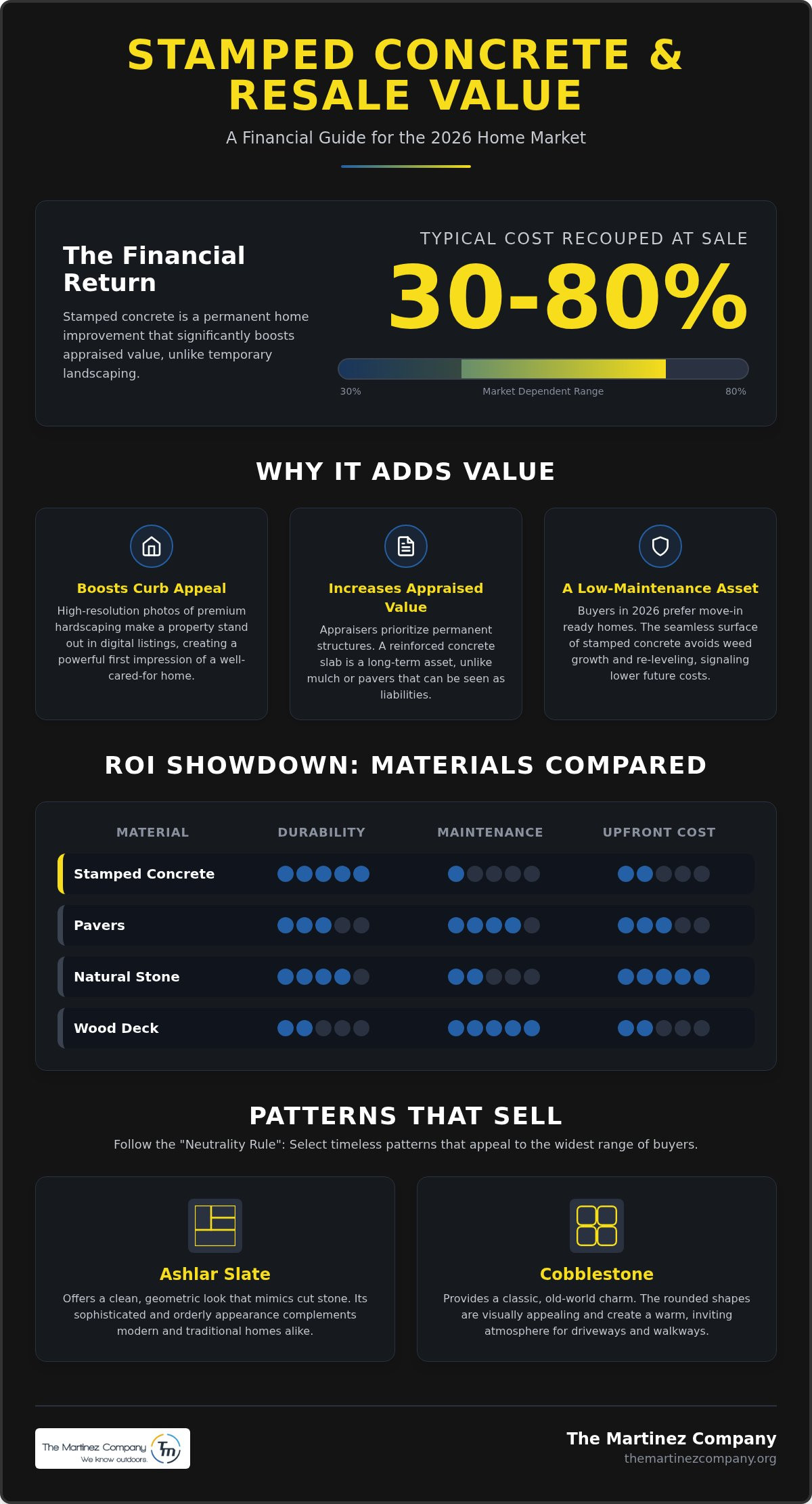
While curb appeal is subjective, appraised value is rooted in data. Professional appraisers prioritize permanent structures that offer long-term stability. Unlike mulch, gravel, or seasonal plantings that require constant replacement, a precision-poured concrete patio is a permanent improvement to the land. National reports indicate that a stamped concrete patio typically recoups between 30% and 80% of its cost at resale. This ROI fluctuates based on local "comps," or comparable sales. If your neighborhood features high-end outdoor living spaces, a stamped concrete upgrade ensures your property meets the expected standard of excellence, protecting your equity from downward adjustments. It is about matching the neighborhood's peak potential while offering a durability that temporary materials simply cannot match.
ROI Comparison: Stamped Concrete vs. Alternative Materials
Every outdoor material carries a "resale clock." Wood decks begin a countdown to rot the moment they're finished; natural stone requires expensive, specialized labor that inflates the initial buy-in without always promising a proportional return. When determining if is stamped concrete a good investment for resale, homeowners must look at the longevity of the asset. Modern buyers are increasingly wary of high-maintenance features. They want the aesthetic of stone without the structural headaches of individual units that shift over time. Data from the Outdoor Remodeling ROI reports highlights that permanent, hard-surfaced patios are among the most desired features for residential listings in 2026. A precision-poured slab resets the resale clock, offering a decade or more of "like-new" performance.
Concrete vs. Pavers: The Maintenance Gap
Paver systems are vulnerable. They rely on sand-filled joints that eventually invite weed growth and ant hills. This creates a visual "maintenance debt" that savvy buyers spot immediately during an inspection. In contrast, a reinforced concrete slab offers a monolithic, seamless surface. It provides superior structural integrity because the weight is distributed across a single, unified structure rather than individual blocks. While pavers can cost between $10 and $35 per square foot, stamped concrete often delivers the same visual impact for 20% to 50% less in total material and labor costs. Over a 10-year period, the cost-to-value ratio heavily favors concrete. It avoids the recurring need for re-leveling or intensive weed mitigation that often deters prospective homeowners.
Concrete vs. Natural Stone: The Luxury Perception
Natural stone like travertine or slate carries a heavy price tag that can be difficult to recoup in a standard residential market. Stamped concrete allows you to mimic these high-end textures with absolute precision. This creates a luxury appearance that boosts your net ROI by keeping the upfront investment manageable. Consistency is the secret to a great listing. In professional real estate photography, a uniform stamped pattern looks cleaner and more intentional than the irregular gaps or color variations found in raw stone. It provides a polished, high-end backdrop for comprehensive outdoor living spaces that feel like a true extension of the home's interior. This uniformity ensures that the finish remains consistent from the first step to the last, projecting a sense of meticulous craftsmanship to every visitor.
Selecting Patterns and Colors for Maximum Market Appeal
Design choices represent the pivot point between a high-yield asset and a sunk cost. When asking is stamped concrete a good investment for resale, you must apply the "Neutrality Rule" to every aesthetic decision. This rule dictates that you should choose patterns and colors that appeal to the widest possible buyer pool rather than catering to niche personal tastes. A bright, highly customized patio might suit your current lifestyle, but it often looks like a future demolition project to a buyer with different preferences. You want to provide a sophisticated canvas that allows others to envision their own outdoor furniture and decor within the space.
The 2026 market favors three specific "market-safe" patterns that consistently drive value. Ashlar Slate offers a timeless, multi-dimensional look that complements almost any architectural style. Wood Plank patterns provide the warmth of a deck with the structural permanence of a slab, making them a favorite for modern farmhouse designs. Cobblestone remains the gold standard for driveways and entryways, projecting an image of established, high-end craftsmanship. Stick to earth tones and grays to ensure the finish feels organic. These muted palettes harmonize with the surrounding landscape and prevent the property from feeling dated as trends shift.
The Power of Texture in Hardscaping
Subtle textures often yield a higher ROI than deep, aggressive stamps. Seamless skins provide a continuous stone-like surface without the deep grout lines that can collect debris or become difficult to navigate. This choice offers a significant safety advantage. Slip resistance is a critical selling point for families with children or retirees looking for a "forever home." The long-term durability of concrete ensures these textures remain functional and visually sharp even after years of foot traffic. High-quality texturing also serves a practical purpose by masking minor wear and tear that naturally occurs over time.
Color Longevity: Integral Pigments vs. Surface Stains
Resale value depends on the finish looking as good in five years as it does on the day of the pour. Integral pigments are mixed directly into the concrete before it leaves the truck, ensuring the color exists through the entire depth of the slab. This is superior to top-applied stains, which can flake or show gray concrete if the surface is chipped. UV-resistant pigments are mandatory for long-term ROI because they prevent the "washed out" look that suggests neglect to a prospective buyer. When the color remains vibrant and deep, it reinforces the perception of a premium, well-maintained estate. This technical precision protects your investment from the fading that often plagues lower-quality decorative projects.
Durability and Maintenance: The Hidden Selling Points
Maintenance is no longer a footnote; it's a liability in the eyes of the 2026 buyer. When evaluating is stamped concrete a good investment for resale, you must position the ease of ownership as a premium feature. A wood deck demands annual staining and a paver patio invites a constant battle with weeds. Stamped concrete requires only a simple rinse and a periodic seal. This simplicity becomes a powerful marketing tool in your listing description. It transforms the backyard from a weekend project into a sanctuary of permanence.
The Sealing Schedule: Protecting Your Investment
A high-quality sealant acts as a protective shield against UV rays and moisture. You should plan to reseal every two to three years to preserve the "wet look" or a sophisticated matte finish. If you're preparing to list your home, a fresh seal acts as a structural facelift. It restores the depth of color and hides minor surface abrasions. While DIY options exist, professional application ensures an even coat without the bubbling or peeling that can occur from improper prep work. This meticulous care signals to buyers that the property has been maintained to the highest standard.
Structural Integrity: Avoiding the 'Crack' Stigma
Buyers fear cracks because they associate them with structural failure. Proper subgrade preparation and the use of strategic expansion joints are the only ways to prevent these visual deterrents. We utilize structural reinforcement like rebar and fiber to ensure the slab moves as a single, stable unit. You can explain to a concerned buyer that hairline cracks are often purely cosmetic, but a professional installation by a firm like The Martinez Company serves as a warranty of value. It proves that the project was built for stability and perfection from the ground up. To ensure your outdoor living space meets these rigorous standards, partner with our residential contracting team.
The 2026 Resale Maintenance Checklist
Annual Cleaning: Use a mild detergent and a pressure washer on a low setting to remove organic debris and prevent staining.
Surface Inspection: Check expansion joints for debris to ensure the slab has room to breathe during temperature shifts.
Sealant Assessment: Perform a "water bead" test; if water no longer beads on the surface, it's time for a fresh coat.
Winter Care: Avoid using rock salt or harsh de-icers, which can pit the surface and compromise the finish over time.
Strategic Implementation: Maximizing ROI with The Martinez Company
Execution is the final bridge between a financial theory and a realized profit. While the data confirms that is stamped concrete a good investment for resale, the actual return depends entirely on the precision of the build. Poorly executed concrete becomes a liability that buyers will negotiate against. The "Martinez Standard" eliminates this risk through rigorous engineering and a commitment to structural perfection. We don't just pour a slab; we anchor your property's value with a foundation built to last for decades. This level of craftsmanship allows you to include professional documentation in your Seller's Disclosure. Providing a prospective buyer with the technical specifications of a reinforced, professionally sealed installation transforms a cosmetic upgrade into a certified home improvement.
The Master Plan: Beyond the Concrete Slab
A single patio is a feature, but a cohesive outdoor environment is a lifestyle. Buyers in the 2026 market are looking for a complete narrative. They want to see how the textures of the stamped concrete flow into the privacy of high-quality fencing or the utility of a custom outdoor kitchen. When you leverage a visionary contractor to manage the entire scope, you avoid the "piecemeal" look that often plagues DIY or multi-vendor projects. This synergy creates a finished result that feels intentional and high-end. Integrating your concrete work with professional fence installation provides the security and seclusion that modern families prioritize, significantly increasing the perceived value of the entire estate. It's about moving from an abstract concept to a completed physical structure that leaves no room for buyer hesitation.
Ready to Build Your Legacy?
The transition from a basic backyard to a high-value asset requires a partner who understands the "how" as much as the "what." You need a protective expert who ensures that every joint is precise and every pigment is integral. We've spent years refining our process to ensure that your investment doesn't just look good on listing day; it stays perfect for the next generation of owners. Don't leave your property's equity to chance or amateur execution. Your goals deserve the weight of an established institution that values permanence and accuracy above all else. If you're prepared to turn your vision into a tangible, market-leading reality, it's time to Execute your vision with The Martinez Company. We'll help you build something that stands the test of time and the scrutiny of the market.
Anchor Your Equity in Permanent Design
The 2026 real estate market rewards homeowners who prioritize structural integrity alongside high-end aesthetics. We've demonstrated that is stamped concrete a good investment for resale when you balance market-safe patterns with precision engineering. By selecting neutral tones and maintaining a rigorous sealing schedule, you transform a simple backyard into a move-in ready asset that commands a premium from buyers and appraisers alike.
Since 2014, The Martinez Company has specialized in the technical execution of outdoor living spaces, focusing on stability and perfection in every pour. Our expertise in both structural and decorative concrete ensures that your investment remains as sharp on listing day as it was during the initial project completion. Don't leave your property's future value to chance or amateur execution. Your home deserves the reliability of a visionary partner who builds for the long term. We bridge the gap between abstract ideas and physical results that stand the test of time.
Start your high-ROI property transformation with The Martinez Company. We are ready to turn your vision into a completed, high-value reality that anchors your home's equity for years to come.
Frequently Asked Questions
Does stamped concrete add more value than a standard deck?
Stamped concrete often provides a more stable long-term return than wood decks because it is a permanent, non-combustible structure. While decks require annual staining and are prone to rot, a concrete patio is a structural upgrade that buyers view as a low-maintenance asset. When asking if is stamped concrete a good investment for resale compared to wood, the answer lies in durability. Buyers in 2026 prioritize outdoor spaces that don't come with a future "to-do" list.
How much ROI can I expect from a stamped concrete driveway in 2026?
You can typically expect a return on investment ranging from 30% to 80% for decorative driveway projects. This variation depends on local market trends and how well the design matches neighboring properties. A textured driveway differentiates your home in digital listings, creating an immediate perception of high-end quality. Because the driveway is the first thing a buyer sees, it sets a professional tone for the entire property tour, often leading to stronger initial offers.
Will stamped concrete crack and lower my home's resale value?
Cracking only impacts resale value if it indicates structural failure from poor installation. When installed with proper subgrade preparation and strategic expansion joints, concrete remains a stable asset. Professional contractors use rebar and fiber reinforcement to ensure the slab moves as a single unit. Explaining these technical safeguards to a buyer can build confidence. It proves the home was improved with precision and a commitment to perfection rather than a quick cosmetic fix.
What are the most popular stamped concrete patterns for buyers?
Ashlar Slate, Wood Plank, and Cobblestone are the top choices for maximizing market appeal in 2026. These patterns offer a timeless look that complements various architectural styles without feeling overly customized. Homeowners often find that is stamped concrete a good investment for resale when they stick to these "market-safe" options. Earth tones and muted grays are preferred over bold colors, as they harmonize with the landscape and appeal to the widest possible buyer pool.
How do I maintain stamped concrete so it looks new for a sale?
Maintaining a "like-new" appearance requires a simple cleaning and sealing routine. You should wash the surface with a mild detergent annually to remove organic debris. Resealing the concrete every two to three years preserves the pigment and protects the surface from UV damage. If you're preparing to list your home, applying a fresh coat of high-quality sealant acts as a visual facelift. It restores the depth of color and provides a sophisticated matte or gloss finish.
Is stamped concrete considered a luxury feature by home appraisers?
Appraisers recognize permanent, high-quality hardscaping as a value-add when it aligns with neighborhood standards. Unlike temporary landscaping features like mulch or gravel, stamped concrete is a fixed improvement to the land. It's often categorized as a premium feature because it mimics the look of natural stone while offering superior structural longevity. If your neighborhood features similar high-end finishes, the upgrade helps your home reach its maximum appraised potential during a professional valuation.
Can I stamp existing concrete to save money and still get the ROI?
You can achieve a high-end look using decorative overlays on existing slabs, but the ROI depends on the condition of the original concrete. If the base slab is sinking or severely cracked, an overlay will eventually fail. It's often more cost-effective for long-term resale to invest in a full-depth, reinforced pour. This ensures the structural integrity matches the aesthetic finish. A professional assessment can determine if your current surface is a viable candidate for a high-ROI transformation.
How long does stamped concrete last before it needs to be replaced?
Stamped concrete typically lasts 25 to 30 years when it is professionally installed and maintained. This lifespan is comparable to pavers and significantly exceeds the life of a traditional wood deck. This longevity is a major selling point for buyers who want an outdoor living space that won't require replacement for decades. By focusing on stability and perfection during the initial build, you ensure the asset remains a valuable part of the property's equity for the next generation.


Comments