
20 Essential Questions to Ask a Commercial Contractor in 2026
Could a single overlooked detail in your vetting process lead to a catastrophic structural failure three years from now? Many commercial clients focus solely on the bottom line of a bid while ignoring the invisible indicators of a firm's true reliability. You deserve a partner who values the "how" of the build as much as the "what." We understand the deep-seated anxiety that comes with complex licensing requirements and the looming threat of budget overruns. It's natural to fear that a contractor might cut corners on structural integrity once the project is underway.
This guide provides a professional framework designed to reveal structural integrity, financial stability, and visionary execution. By mastering these 20 essential questions to ask a commercial contractor, you'll gain the confidence to choose a partner who builds for permanence. We will examine the critical inquiries that separate high-end craftsmanship from corner-cutting operations. This ensures your next project achieves both aesthetic and structural finality. We'll move from the initial handshake to a completed physical result that stands the test of time and reflects your unique goals.
Table of Contents
Vetting for Stability: Essential Credential and Licensing Questions
The Blueprint of Accountability: Managing Timelines and Budgets
Probing for Precision: Questions on Specialized Craftsmanship and Materials
The Safety Net: Insurance, Liability, and Long-Term Warranties
Finalizing the Vision: Questions to Ensure Aesthetic and Structural Alignment
Vetting for Stability: Essential Credential and Licensing Questions
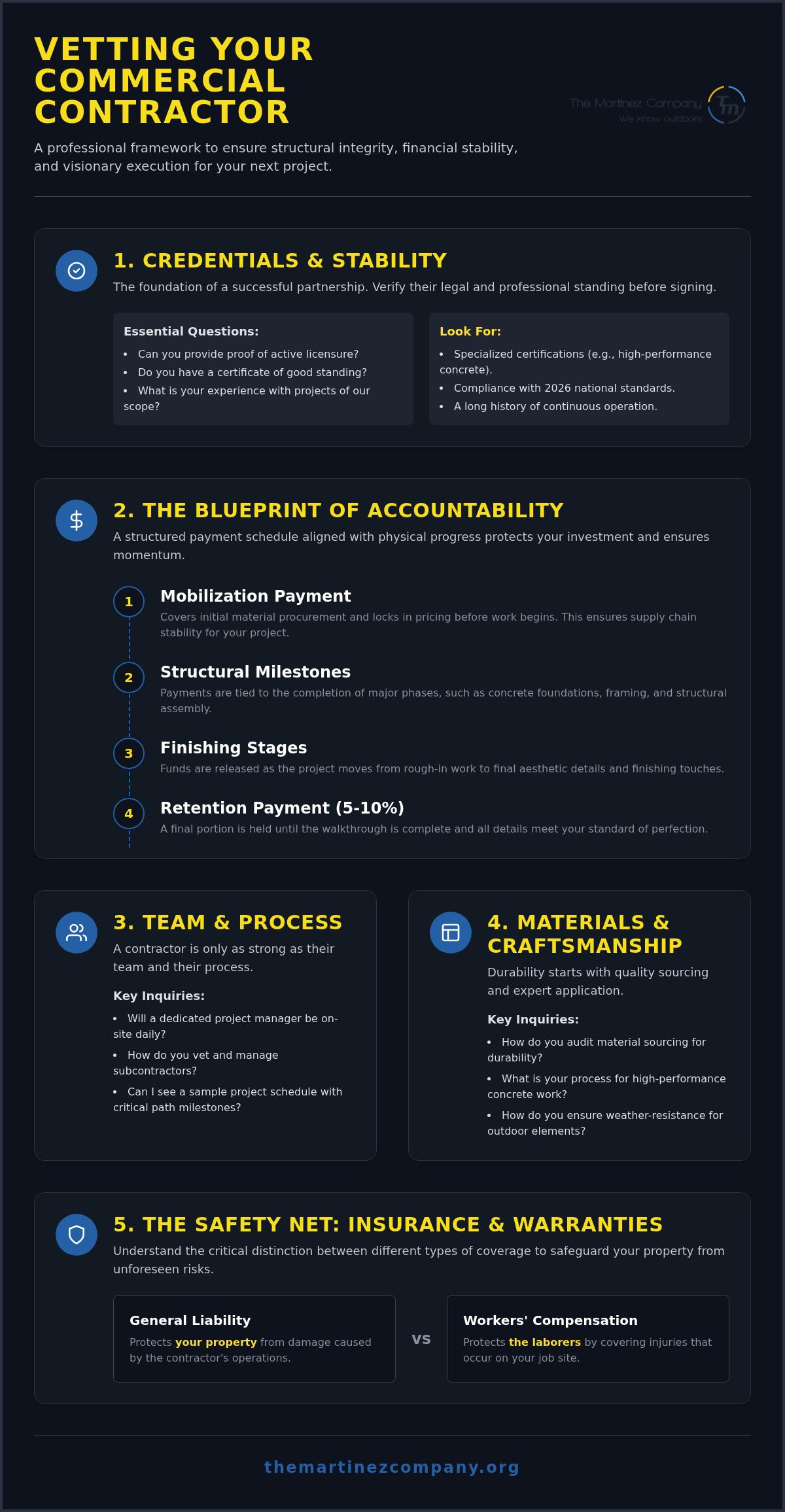
Credentials serve as the backbone of any commercial endeavor. They prove that a firm possesses the technical acumen and legal authority to transform a blueprint into a physical reality. When refining your list of questions to ask a commercial contractor, you must look beyond a simple "yes" or "no" regarding their status. Demand proof of active licensure and registration that satisfies both national requirements and local building codes. A legitimate partner welcomes this scrutiny. It demonstrates their commitment to professional standards and the safety of your future assets.
Verification of Professional Standing
Request a certificate of good standing to confirm proof of continuous operation. This document reveals if a firm has faced legal or financial interruptions that could jeopardize your timeline. A company like The Martinez Company, established in 2014, offers a decade of documented stability. This history suggests a proven track record of navigating complex regulations while delivering consistent excellence. Verify their experience with commercial-grade projects that mirror your specific architectural scope. If your project involves high-performance concrete flatwork, ensure they hold specialized certifications that meet the updated 2026 national standards for precision and durability. Professional associations and design-build certifications further indicate a firm's dedication to the "how" of construction.
Subcontractor Management and Accountability
A general contractor is only as strong as their weakest link. Inquire specifically about how the firm vets their specialized labor for critical tasks like precision concrete work or high-quality fence installation. Will there be a dedicated project manager on-site every day? Constant supervision is vital for maintaining structural integrity and preventing costly errors. The Martinez Company adopts a Reliable Visionary approach; this means taking full ownership of every hand that touches the project. Ask how they ensure third-party crews adhere to the same standards of perfection that the primary firm promises. This clear hierarchy of responsibility ensures that the transition from abstract concept to physical structure remains seamless and secure. You need a partner who acts as a Protective Expert, guarding your investment at every stage of the build.
The Blueprint of Accountability: Managing Timelines and Budgets
Transformation requires more than a handshake; it requires a rigid framework for accountability. One of the most vital questions to ask a commercial contractor involves how they translate a static quote into a living, moving project. In 2026, transparency isn't a luxury. It's the only way to navigate supply chain fluctuations and ensure the realization of your goal. We've seen how hidden costs and scope creep can paralyze a business. A professional firm prevents this by defining the journey from the first abstract idea to the final physical structure with clinical precision.
Defining the Milestone Payment Schedule
Aligning capital with physical progress protects your investment and maintains project momentum. We recommend a four-step sequence to ensure every dollar is accounted for. First, a mobilization payment covers initial material procurement. This ensures stability and locks in pricing before the first shovel hits the dirt. Second, payments are tied to major structural milestones, such as the completion of precision concrete work or framing. Third, funds are released as the project moves from rough-in stages to aesthetic finishing. Finally, a retention payment of 5 to 10 percent is held until the final walkthrough is complete. This ensures every detail meets a standard of perfection before the project is officially closed. Tying payments to physical results keeps the focus on execution.
Timeline Integrity and Delay Mitigation
Hard deadlines demand a rugged confidence that doesn't falter when challenges arise. Weather or structural surprises shouldn't derail your business operations. Ask to see a sample project schedule that highlights critical path milestones for your specific build. This document should illustrate the journey from the first point of contact to the final result. A Reliable Visionary anticipates these hurdles and builds a buffer into the plan. This proactive stance ensures your commercial contracting project stays on track without sacrificing structural integrity. Accuracy in scheduling is just as important as accuracy in the pour. If a contractor can't explain how they'll regain lost time without cutting corners, they aren't the right partner for a high-stakes commercial renovation. You need a partner who values your time as much as the permanence of the build.
Probing for Precision: Questions on Specialized Craftsmanship and Materials
A structure is only as resilient as the raw materials that compose it. When finalizing your list of questions to ask a commercial contractor, you must pivot from administrative details to the technical nuances of the build. High-end architectural design means nothing if the underlying skeleton fails to withstand the elements. You deserve a partner who approaches material sourcing with the eyes of a Protective Expert. Every choice, from the specific mix of a concrete slab to the grade of cedar used in a perimeter fence, dictates the permanence of your project. Don't settle for vague promises of quality. Demand data and specific standards that prove your vision is built to last.
Material Selection and Durability Standards
Inquire about the specific grade of cedar or the PSI rating of the concrete mix intended for your site. For high-end outdoor living spaces, we recommend nothing less than Clear Heart cedar to prevent warping and decay. Ask how the contractor engineers custom structures to manage wind loads and moisture. A Reliable Visionary ensures that outdoor culinary spaces use non-porous stones and marine-grade stainless steel to maintain aesthetic finality. This meticulousness prevents the heartbreak of a beautiful finish that fades after a single season. If they can't define the durability standards of their materials, they can't guarantee the stability of your investment. It's about the journey from a concept to a completed physical result that remains flawless for decades.
Technical Mastery in Structural Concrete
The 2026 national standard for professional concrete flatwork requires a minimum compressive strength of 4,000 PSI integrated with advanced curing agents for climate resilience. Ask your contractor about their reinforcement methods. Do they rely on standard wire mesh, or do they utilize a grid of Grade 60 rebar for superior structural durability? Rebar provides the rugged confidence needed for high-performance driveways and heavy-use commercial slabs. You should also ask how they integrate decorative finishes without compromising the core strength of the pour. Precision concrete work is a science. It requires an expert who understands how to balance aesthetic goals with the physics of load-bearing structures. We focus on the "how" of the build to ensure that every square inch of your property reflects perfection and structural integrity. This ensures your project achieve a level of excellence that transcends the industry average.
The Safety Net: Insurance, Liability, and Long-Term Warranties
Protection is the silent foundation of a successful build. It transforms a risky venture into a secure, long-term investment. When refining your list of questions to ask a commercial contractor, you must look beyond a simple certificate of insurance. You need to understand the nuances of their coverage. A Protective Expert doesn't just manage a job site; they manage the risk associated with your property. This ensures that every phase of the project, from the first excavation to the final aesthetic finish, is shielded from unforeseen liabilities. Rugged confidence comes from knowing your assets are safe.
Comprehensive Liability and Risk Coverage
Distinguish clearly between general liability and workers' compensation. General liability protects your property and third parties from damage or injury caused by the construction process. Workers' compensation covers the laborers themselves. If a contractor lacks either, the financial burden could fall on you. When considering the questions to ask a commercial contractor, don't forget to inquire about the specific limits of their liability policy. Request proof of insurance that specifically covers precision concrete work and structural tasks. For large-scale commercial projects, standard policy limits are often insufficient. Ensure the limits match the scale of your investment. You must also verify that all subcontractors carry equivalent coverage. This creates a seamless safety net that leaves no room for error. We believe in a transparent approach to risk. It's the only way to move from an abstract plan to a physical result with total security.
Post-Construction Security and Warranties
A project doesn't end when the crew leaves the site. True stability requires a long-term commitment to the work performed. Ask about the duration and scope of structural warranties, especially for concrete flatwork and outdoor structures. Does the warranty cover only the materials, or does it include the workmanship itself? A Reliable Visionary stands behind their craft long after the final walkthrough. Inquire about the written protocol for handling "perfection adjustments" once the project closes. You need to know the expected response times for warranty claims. A professional firm provides a clear roadmap that guides you from the initial handshake to the final, post-construction support phase. This ensures your project maintains its aesthetic and structural finality for years to come. Partner with a firm that prioritizes your peace of mind. Explore our commercial contracting solutions to see how we protect every square inch of your build.
Finalizing the Vision: Questions to Ensure Aesthetic and Structural Alignment
The realization of a complex build requires a seamless bridge between your abstract goals and the physical result. You need to know that your partner understands the "why" behind the design as much as the "how" of the construction. This final phase of vetting focuses on the communication rhythm and the specific mechanisms used to ensure the finished structure matches the initial blueprints. An Action-First project kickoff meeting is non-negotiable. It sets the tone for the entire relationship. This is the moment where the Reliable Visionary translates your unique objectives into a concrete plan of action. Visualizing the final result through 3D modeling or detailed blueprints is a standard part of a professional process. It eliminates the gap between imagination and physical structure.
Communication Protocols and Project Visibility
Project visibility is the antidote to anxiety. One of the critical questions to ask a commercial contractor is which digital tools they use for real-time updates. You shouldn't have to guess the status of material deliveries or labor schedules. Ask if they use specialized project management platforms that allow you to track progress from any device. How often will you receive formal status reports? A professional firm provides consistent updates that document the journey from a concept to a completed physical result. You must also establish a primary point of contact for visionary changes. Construction is dynamic. If a design element needs adjustment mid-build, you need a direct line to the person who can execute that change without compromising structural integrity. This ensures that the momentum of the project never falters due to a lack of clarity.
The Final Walkthrough and Perfection Standards
The transition from a dusty construction site to a polished, professional space is the ultimate test of a contractor's standards. You are looking for aesthetic finality and structural mastery. Inquire about how the punch list is managed to ensure every detail meets a standard of perfection. This process shouldn't be a struggle. It should be a methodical verification of the rugged beauty and permanence promised at the start. Ask about the specific steps taken to clean and prep the site for immediate use. A project isn't finished until the site reflects the high-end architectural design you envisioned. By asking these questions to ask a commercial contractor, you ensure that the final result isn't just a building; it's a realized vision that stands as a testament to quality and precision. We focus on this finality to ensure our clients feel the full weight of a successful transformation. Every square inch must reflect the meticulousness of the build.
Building for Permanence: Your Next Steps in Commercial Excellence
Success in commercial construction begins long before the first pour. By mastering these questions to ask a commercial contractor, you've moved from uncertainty to a position of rugged confidence. You now possess the professional framework to verify structural integrity, enforce financial accountability, and ensure that every material choice reflects your unique vision. A project built to last requires a partner who values the "how" of the build as much as the "what." This methodical approach transforms abstract plans into physical structures that stand as testaments to quality and stability.
The Martinez Company has delivered perfection in every build since 2014. We specialize in precision structural concrete and high-end outdoor living, bringing a Reliable Visionary perspective to every project. Our commitment to accuracy and aesthetic finality ensures your investment is protected for decades. Don't settle for a contractor who cuts corners when you can work with a Protective Expert dedicated to your goals. Partner with the Reliable Visionaries at The Martinez Company for your next project and watch your vision take shape with clinical precision. Your journey toward a flawless physical result starts with a single, decisive step. We're ready to build something that lasts.
Frequently Asked Questions
What is the most important question to ask a commercial contractor before signing?
The most critical inquiry focuses on the contractor's specific plan for managing structural risks and technical execution. You need to know if they can translate an abstract idea into a physical result without compromising safety. Ask for a documented workflow that demonstrates their approach as a Reliable Visionary. This reveals their level of preparation and commitment to perfection. It ensures your project achieves structural integrity from the very first day.
How do I verify if a general contractor is actually licensed and insured in 2026?
You should use state-level digital verification portals to confirm active status for licenses and registrations. Request a Certificate of Insurance (COI) that names you as the additional insured. This document must come directly from their insurance agent to prevent fraud. In 2026, verify that their coverage specifically includes high-performance concrete work. This protects your investment from liabilities during complex commercial renovations or new builds across the country.
Can a general contractor handle both commercial and residential projects effectively?
Many firms effectively manage both sectors by applying high-level craftsmanship across different project scales. The Martinez Company has excelled in commercial and residential contracting since 2014. The technical requirements for precision concrete or custom outdoor living spaces remain consistent. A professional firm uses the same standards of durability and aesthetic finality for a corporate courtyard as they do for a luxury home. It's about maintaining a commitment to stability.
What should be included in a professional construction contract for outdoor living?
A robust contract must specify material grades, such as Clear Heart cedar, and concrete PSI ratings to ensure long-term durability. It should outline a milestone payment schedule tied to physical progress. Include a final walkthrough retention clause to guarantee every detail meets your standards for perfection. This document acts as your safety net. It translates your unique goals into a legally binding blueprint for a structure built to last.
How do I know if a contractor’s quote is fair for specialized concrete work?
Compare the quote against current 2026 national standards for commercial concrete flatwork. A fair price for precision concrete work accounts for a minimum 4,000 PSI mix and Grade 60 rebar reinforcement. If a bid is significantly lower, the contractor might be cutting corners on structural integrity. You're investing in permanence. A quote from a Reliable Visionary reflects the true cost of high-level craftsmanship and weather-resistant materials.
What happens if a commercial contractor goes over the initial budget?
Professional firms utilize a transparent change order process to manage any deviations from the original estimate. This ensures that you approve every additional cost before work proceeds. When considering the questions to ask a commercial contractor, inquire about their strategies for preventing scope creep. Detailed pre-construction planning typically identifies potential hurdles early. This proactive stance keeps the project on track and protects your budget from unexpected structural surprises.
Why is it important to ask about subcontractor management protocols?
Subcontractor management dictates the overall quality of the specialized labor on your site. You need to know if a dedicated project manager will be present daily to oversee third-party crews. This ensures that every worker adheres to the firm's core values of stability and perfection. Asking about these protocols reveals if the contractor acts as a Protective Expert. It guarantees that the "how" of the build remains consistent across all trades.
What is the difference between a general contractor and a specialized build firm?
A general contractor manages the entire project lifecycle and various trades; a specialized firm focuses on a single craft like concrete or fencing. The Martinez Company operates as a comprehensive contracting firm with deep technical expertise in specialized construction. This hybrid approach allows us to maintain the broad vision of a general contractor while delivering the precision of a specialist. You get the benefit of a single point of accountability.


Comments