
Commercial Fence for Storage Facilities: Heights and Costs
An eight-foot perimeter fence is the industry-standard starting point for self-storage, but height alone does not determine how well a commercial fence for storage facilities fits the property. Local requirements, site layout, access needs, and stored items all shape the right choice. A taller fence cannot make up for weak gates, poor lighting, or gaps in perimeter planning.
It’s reasonable to want a clear answer about height and cost before moving ahead. This guide explains how to compare fence materials and security features, what affects a project estimate, and how to assess possible insurance effects without assuming a fence will change your rates. You’ll also see why gates, cameras, lighting, and vehicle movement belong in the plan from the start. The goal is a perimeter designed around how your storage property operates, not a height chosen in isolation.
Table of Contents
Does storage facility fencing affect insurance rates?
Fencing contributes to a storage property’s security plan, but the fence alone does not determine whether insurance rates will change. Its value depends on how it works with cameras, lighting, gates, and site procedures.
Security and Property Appearance
Perimeter fencing defines the property’s boundary and shapes how visible and orderly the storage site appears. Chain link preserves sightlines for staff and surveillance cameras, while solid screening can create blind spots. Coordinate fence visibility with camera placement, lighting, patrol routes, and privacy needs. That balance supports a clear appearance and practical security coverage.
Fence Upgrades and Climb Resistance
Chain-link security upgrades strengthen a perimeter’s resistance to cutting or climbing. A chain-link fence can be breached with bolt cutters in a few minutes, so the mesh alone shouldn’t carry the full security plan. Three-strand barbed wire on 45-degree outrigger arms is one commercial security detail. Review deterrents against local rules, lease requirements, zoning, and property conditions before including them.
Fence Height and Applicable Rules
Height adds a physical barrier, but it cannot correct weak gates, excessive clearance at the bottom, poor lighting, or uncontrolled access points. Local zoning determines permitted fence height, and there is no single limit for every storage property. Building and fire requirements may also affect a project, so applicable rules depend on the site and jurisdiction. Review them as part of the fence plan rather than relying on height alone.
Security Risks and Installation Mistakes
Common security gaps include poorly placed cameras, weak posts, open gate areas, and insufficient lighting. A taller fence will not resolve these weaknesses. Plan fencing, gates, locks, access control, cameras, lighting, and normal site procedures as one system. For example, align camera views with fence lines and entry points, then account for blind spots and patrol routes. This integrated approach helps prevent an overlooked opening or weak connection from undermining the perimeter.
What Fence Height Works Best for a Storage Yard?
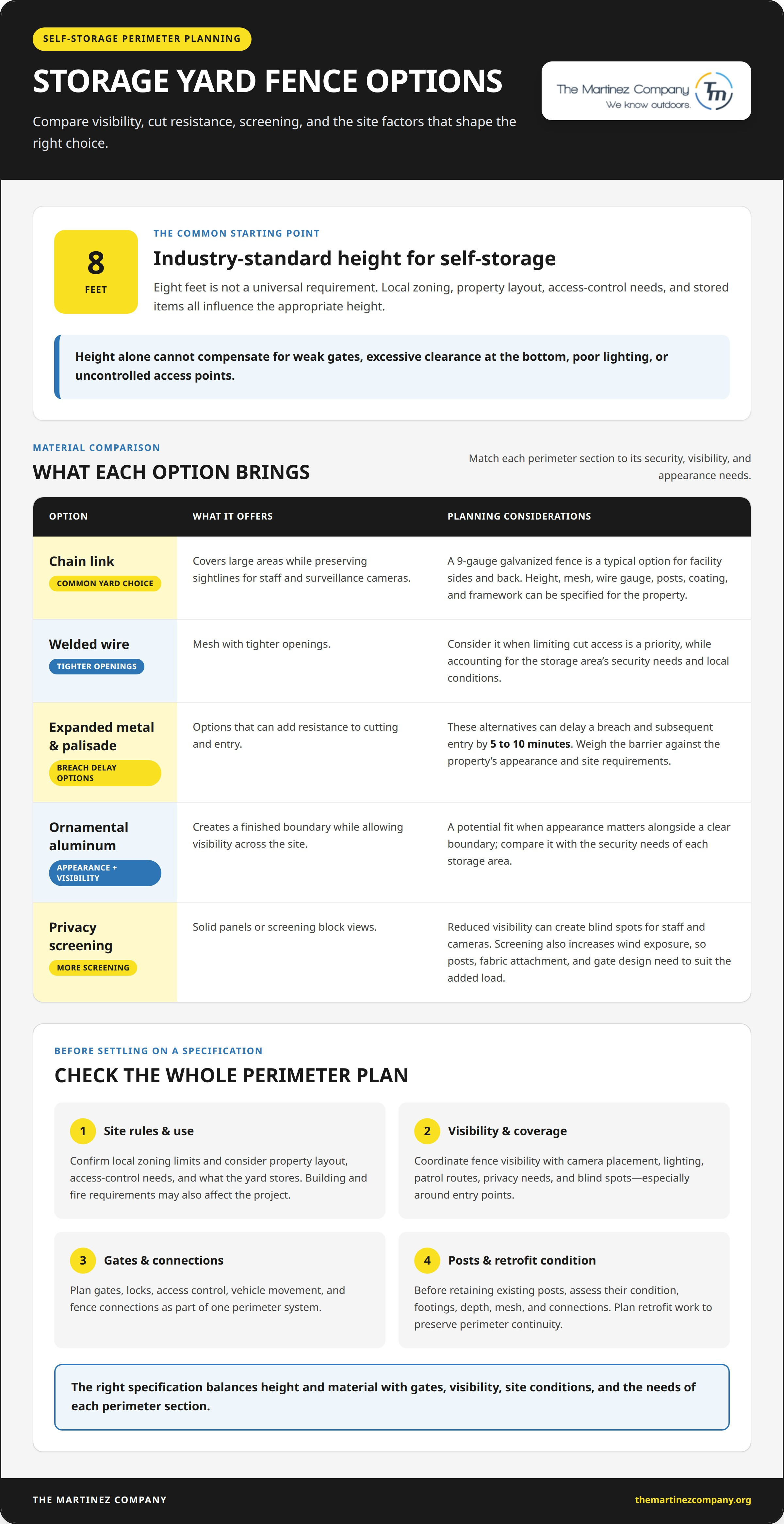
Eight feet is the industry-standard height for self-storage perimeter fencing, but it is not a universal requirement. The right height depends on local rules, property layout, access-control needs, and what the yard stores. A commercial fence for storage facilities should fit those site conditions rather than follow a height choice in isolation.
Chain link is a common choice for storage yards because it covers large areas while preserving visibility for staff and cameras. A 9-gauge galvanized chain-link fence is a typical perimeter option for facility sides and back. Its height, mesh size, wire gauge, posts, coating, and framework can be specified to suit the property. Match the security fence design to the exposure and use of each perimeter section.
Welded-wire mesh offers tighter openings when limiting cut access is a priority. Expanded metal and palisade fencing are other options that can delay a breach and subsequent entry by five to 10 minutes. Ornamental aluminum can suit a property where appearance matters alongside a clear boundary. Material selection should still account for the yard’s security needs and local conditions. Choosing a commercial fence for storage facilities means weighing these material differences alongside the planned height.
Existing chain-link fence posts may be part of a retrofit, but the entire fence system needs assessment. A contractor can evaluate post condition, footings, height, mesh, and connections before planning replacement sections or upgrades. Concrete footings and post depth affect long-term maintenance, so retaining posts without assessing their support can undermine the finished fence. A retrofit also needs a layout that preserves perimeter continuity during the work.
Height alone will not resolve weak posts, open access points, or poor visibility. For example, an eight-foot fence may still leave a vulnerable boundary if the mesh ends above grade or cameras miss the vehicle gate. Set the height based on stored items, camera views, gate layout, and local zoning limits. Requirements vary by jurisdiction, so permitted height must be part of project planning. This gives operators a practical basis for choosing chain link, welded wire, or aluminum without treating one material or height as right for every storage yard.
Local zoning limits can determine permitted fence height, and requirements vary by jurisdiction. Include those limits in project planning.
Commercial perimeter fencing for self-storage facilities
A self-storage fence system should match the security, visibility, and appearance needs of each perimeter section. Maintenance needs and service life depend on coating, corrosion exposure, footing and post depth, hardware quality, and ongoing condition. These factors help determine when components need attention, repair, or replacement.
Expanded metal, welded wire, and palisade fencing are alternatives when greater cut resistance matters. Welded-wire mesh has tighter openings, while expanded metal and palisade can delay a breach. The choice affects both the barrier and the property’s appearance. Ornamental metal fencing, including aluminum, creates a finished boundary while allowing visibility across the site. Compare these materials with camera coverage and the security needs of each storage area.
Privacy fencing trades visibility for screening. Solid panels or screening can block views for staff and cameras, creating blind spots along the perimeter. Screening also increases wind exposure, so posts, fabric attachment, and gate design need to suit the added load. For example, a screened section near a public-facing boundary may serve a different purpose from an open fence along a camera-covered side.
Installation details connect material choice to long-term performance. Concrete footings, post depth, and hardware quality all affect maintenance needs. In coastal locations, complete polymer-coated chain-link systems offer greater corrosion resistance. At a property with damaged sections, replacing fence sections one at a time can avoid leaving perimeter gaps overnight. A planned maintenance review can track loose hardware, damaged mesh, coating wear, and changes in ground conditions. Addressing these issues early helps preserve coverage and directs repairs to the components that need them, rather than treating the whole fence as one uniform system.
Warehouse fence estimates and project scope
A useful estimate defines the fence, gate, access-control, and site work as one coordinated scope. A clear scope makes proposals easier to compare and clarifies what installation involves.
Estimate Scope and Project Details
A warehouse fence estimate should describe the work and conditions that shape the layout. It should identify fence specifications, section lengths, gate locations and widths, access-control needs, and site conditions. It should also state whether gate hardware, locks, operators, access equipment, old-fence removal, disposal, and special preparation are included. These details reveal differences between proposals.
Drainage, grade changes, soil, utilities, loading docks, and property boundaries can affect placement and labor. For example, a sloped section may need a different layout from a level loading area. Plan gate openings and operator locations alongside cameras, power, and regular vehicle flow—such as accommodating transport trucks from relocation providers like Orange Movers & Storage—to reduce retrofit work and disruption.
Choosing Contractors and Comparing Quotes
When selecting a commercial fence contractor, compare the written scope, specified materials, gate details, access-control work, and site preparation. Look for clear coverage of every section, including openings and connections to existing fencing. Compare like with like: a proposal that excludes old-fence removal or gate hardware does not cover the same work as one that includes those items.
Local zoning and municipal requirements can affect fence and gate plans, so account for the site’s jurisdiction in the project scope. A swing gate needs room for its opening arc; a sliding gate needs side space to travel.
Professional installation begins with reviewing boundaries, utilities, drainage, grade, soil, and daily vehicle routes. The contractor then coordinates fence sections and openings with gate placement, access equipment, and site conditions. After preparation, the crew installs the specified posts, framework, fence material, and hardware, then completes the gate and access-control components included in the scope. This sequence connects the estimate to the finished perimeter.
Discuss your storage facility fence project to define a clear scope from site conditions through gate openings and installation.
The Martinez Company: Commercial Contracting
The Martinez Company provides Commercial Contracting and Fence Installation for storage properties that need a perimeter planned around their layout and daily use. Turn to the team when you’re ready to move from comparing fence heights and materials to defining an installation scope. Fence placement, gate openings, access needs, and site conditions all shape how the finished perimeter serves the property.
A clear project begins with understanding the site’s needs. The Martinez Company can translate those priorities into a commercial fence installation that fits the storage facility. For a project involving broader construction needs, Commercial Contracting offers a natural next step.
Contact The Martinez Company to discuss your storage facility fencing project.
Build a Perimeter That Fits Your Plans
Make the next step a clear project scope that supports how your storage property operates today and can adapt as its needs change. A commercial fence for storage facilities is part of a larger site plan, connecting the perimeter with access, appearance, and daily movement. Keep those priorities in view as you move from early decisions to a finished installation.
The Martinez Company offers Commercial Contracting and Residential Contracting, along with Outdoor Living Spaces. For a storage property project, the focus can stay on translating your site needs into a defined construction plan. A conversation can help establish what the work should address and how the project fits your broader property goals.
Contact The Martinez Company to discuss your plans and take the next step toward a well-considered project.
Frequently Asked Questions
How tall should a self storage perimeter fence be?
Eight feet is the industry-standard height for a self-storage perimeter fence, but local zoning and site needs still matter. A property with uneven grade, multiple vehicle entrances, or different storage areas may need a layout that treats each boundary consistently. Use the standard height as a planning reference, then account for local limits, access points, and stored items before finalizing the design.
Can different fence types be mixed on the same perimeter?
Yes, a perimeter can combine fence types to serve different areas. For example, a facility might use chain link along camera-covered sides and a more visually finished material near its public entrance. The design should preserve secure connections where materials meet and avoid creating gaps or abrupt changes in coverage. Gate openings, property lines, and the transition between fence sections all need to fit the overall layout.
How Do Cameras, Lighting, and Visibility Affect Fence Choice?
Camera views and lighting should guide where a fence allows clear sightlines and where screening makes sense. For example, an open fence beside a camera-covered drive can maintain visibility, while a screened area may suit a boundary where privacy is a priority. Map camera views, light coverage, patrol routes, and likely blind spots together. A fence that blocks a camera’s view can weaken the value of that coverage.
Is Chain Link Fencing a Good Choice for Warehouse Security?
Chain link can suit warehouse security when visibility and broad perimeter coverage are priorities. It lets staff and cameras see through the boundary, which can help monitor vehicle entrances and loading areas. Its suitability depends on the property’s exposure and security plan, since chain link can be cut. A warehouse storing sensitive inventory may need stronger mesh or another material in selected sections.
Should a Warehouse Use Swing Gates or Sliding Gates?
Choose a gate style based on available space and vehicle movement. Swing gates need room for their opening arc, so they can conflict with traffic in a tight drive lane. Sliding gates need space beside the opening to travel. A warehouse with frequent truck and trailer movements should also plan turning paths, delivery routes, and emergency access around the gate location. For automated installations, consulting dedicated entry specialists like Gate Tech Pros can help ensure operators and track hardware suit the facility's daily traffic volume.
What Are the Best Warehouse Fencing Options for Storage Yards?
The best option depends on the yard’s visibility, appearance, and resistance needs. Chain link suits large boundaries where camera sightlines matter. Welded-wire mesh offers tighter openings, while expanded metal or palisade can delay a breach. Ornamental aluminum can create a more finished public-facing edge. A mixed layout can match materials to different sections, provided transitions, gates, and site operations are coordinated.


Comments