
Commercial Polished Concrete: The Definitive Buyer's Guide
- estrellahernandezt9
- 11 minutes ago
- 12 min read
A floor that requires constant waxing and stripping isn't an asset; it's a liability that drains your operational budget and slows your momentum. You need a surface that reflects your brand's quality without the endless cycle of costly repairs. This guide empowers you to master the strategic advantages of polished concrete floors for commercial buildings to transform your facility into a high-performance asset. We understand the hesitation. You've likely felt the frustration of dull, high-maintenance surfaces or the fear that a high-gloss finish might lead to slip-and-fall hazards in your highest traffic zones.
Confusion over technical specs like "cream" versus "salt and pepper" finishes shouldn't stall your project. We'll show you how to achieve a low-maintenance floor designed to last over 20 years while meeting the strict 2026 OSHA slip-resistance standards. From navigating the new LEED v5 decarbonization credits to selecting the perfect grit level for your specific industry, you'll gain the clarity needed to move from a conceptual design to a permanent, structural masterpiece. Let's build something that lasts.
Table of Contents
The Strategic Evolution of Commercial Polished Concrete
The transformation of a raw concrete slab into a high-performance architectural element represents a fundamental shift in commercial design strategy. Polished concrete floors for commercial buildings are no longer viewed as mere industrial defaults; they are the result of a precise, multi-step mechanical process of grinding, honing, and polishing a slab with industrial diamonds. This isn't a temporary coating that sits on top of the floor. It's a structural refinement that works from within the material itself. Commercial leaders are increasingly abandoning solutions like LVT and VCT. They've realized that plastic-based tiles and adhesive-heavy planks fail under the pressure of high-traffic environments, leading to costly replacement cycles and environmental waste. Modern office and retail design has moved from "industrial gray" to a new era of architectural elegance where the floor serves as a sophisticated, light-reflective canvas.
The Science of Subsurface Refinement
This process goes beyond surface-level aesthetics. Mechanical grinding actually changes the molecular density of the concrete. By closing the pores of the slab, we create a surface that resists penetration from oils and contaminants. We utilize chemical densifiers to react with the free lime in the concrete. This creates a "dust-proof" environment that is essential for healthcare facilities and precision manufacturing hubs. The journey from a rough, porous concept to a completed, glass-like structure is what dictates the final aesthetic clarity. It's a meticulous progression where the quality of the initial pour determines the perfection of the final polish.
Performance Benefits for High-Traffic Facilities
Durability is the core of our craft. Polished concrete offers impact resistance that outlasts every other commercial flooring category. It doesn't chip like ceramic tile or tear like luxury vinyl. Beyond sheer strength, there is the strategic advantage of light reflectivity. High-gloss finishes amplify both natural and artificial light; this can significantly reduce energy costs for large-scale facilities. Safety remains the absolute priority. Modern finishes for polished concrete floors for commercial buildings meet and exceed the 2026 OSHA requirements for a coefficient of friction of 0.5 on level surfaces. You achieve a mirror-like shine without compromising the safety of your staff or customers.
Environmental impact is now a boardroom priority. As of July 1, 2026, all new projects registering for LEED certification must adhere to the new LEED v5 standards. Polished concrete contributes directly to these goals by reducing embodied carbon and eliminating the need for high-VOC adhesives or coatings. It's a choice for permanence that respects both your budget and the planet.
Decoding the Specs: Aggregate Exposure and Gloss Levels
Precision in specification is what separates a standard floor from a high-performance asset. When planning polished concrete floors for commercial buildings, you must define the relationship between aggregate exposure and gloss levels early in the design phase. These aren't just aesthetic choices. They dictate how the floor will handle heavy foot traffic and how much light it will reflect back into your space. The final result depends entirely on the initial pour and trowel technique; a slab that wasn't finished flat can limit you to deeper aggregate cuts regardless of your original vision.
Aggregate Exposure: The Visual Texture
Aggregate exposure refers to how much of the internal stone and sand is revealed during the grinding process. We categorize this into levels that determine the floor’s "personality."
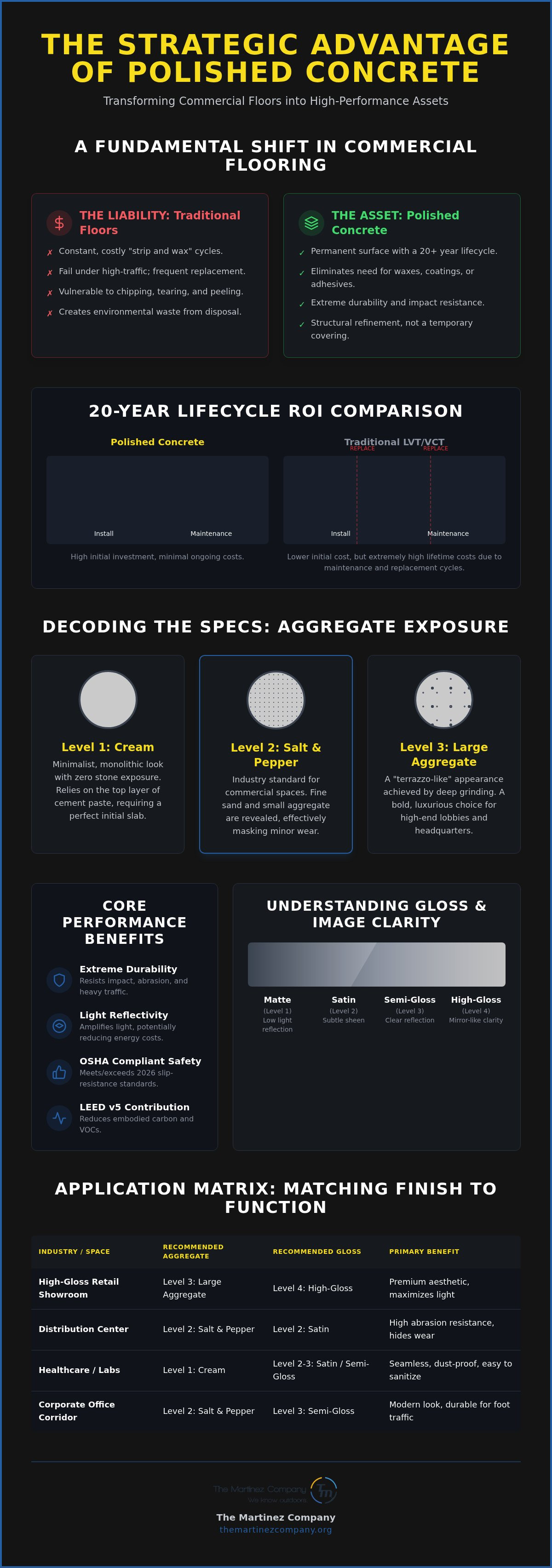
Level 1 (Cream): This provides a monolithic, minimalist look with zero stone exposure. It relies on the "cream" or top layer of the cement paste. It requires a near-perfect initial finish to achieve uniformity.
Level 2 (Salt and Pepper): This is the industry standard for commercial corridors. It reveals fine sand and small specks of stone. This finish is popular because it offers a modern aesthetic that masks minor scuffs and daily wear effectively.
Level 3 (Large Aggregate): This creates a "terrazzo-lite" look by grinding deep into the slab to reveal the largest stones. It's a bold choice for high-end lobbies and corporate headquarters that demand a sense of permanence and luxury.
Gloss Levels: Managing Light and Maintenance
Gloss levels define the "Image Clarity" of the floor. This is a technical measurement of how clearly an object is reflected in the surface. Choosing the right level is a balance between visual impact and the reality of your maintenance budget.
Level 1 (Matte): Typically achieved at a 100-grit resin bond, this is the go-to for warehouses. It provides a clean, dust-proof surface where utility outpaces aesthetics.
Level 2 (Satin): At a 400-grit level, this finish offers a soft glow. It's the perfect middle ground for facilities that want a professional look with lower daily maintenance requirements.
Level 3 & 4 (High Gloss): These levels, reaching up to 3000-grit, provide a mirror-like reflection. They maximize the "wow factor" in luxury retail and automotive showrooms, though they require more frequent attention to maintain their clarity.
For heavy-load environments, the grit sequence is non-negotiable. Skipping steps in the transition from metal-bond to resin-bond diamonds leads to premature wear and surface failure. A truly durable floor requires a methodical progression to ensure the surface is properly refined and densified. When you partner with the expert concrete contracting team at The Martinez Company, we ensure the grit sequence is tailored to your facility's specific load requirements to guarantee a result that lasts for decades.
Calculating the Lifetime ROI: Maintenance vs. Installation
When you evaluate polished concrete floors for commercial buildings, looking only at the initial bid is a strategic error. You must consider the 20-year lifecycle to understand the true value of your investment. Most commercial flooring options are a recurring expense. They are products you buy today only to replace tomorrow. Polished concrete is different. It's a one-time structural refinement of the building itself. By utilizing the existing slab, you eliminate the need for secondary materials that eventually fail, peel, or stain. It represents a transition from a recurring liability to a permanent, high-performance asset.
The Hidden Costs of Traditional Flooring
Traditional floors like VCT or carpet tiles carry a heavy financial and environmental burden. Carpet tiles often require full replacement every five to seven years in high-traffic retail or office settings. This creates an endless cycle of procurement costs, installation labor, and landfill waste. Resilient floors like VCT are even more demanding. They're notorious for their labor-intensive maintenance schedules. They require a constant cycle of stripping and waxing to maintain a professional appearance. These chemicals are expensive and harmful to indoor air quality. Beyond the direct costs, moisture-related failures in tile or luxury vinyl can derail your operations entirely. Polished concrete removes these risks by allowing the slab to breathe. This prevents the delamination common in adhesive-based systems.
Simplified Maintenance Protocols
Maintenance shouldn't be a drain on your operational budget. Daily care for a polished surface is remarkably efficient. A simple microfiber mop and a neutral pH cleaner are usually sufficient to remove surface dust and maintain clarity. This eliminates the need for the heavy chemicals and specialized labor required by other systems. Periodic high-speed burnishing with a diamond-impregnated pad can restore the original gloss without ever needing a drop of wax. For high-traffic zones like main entryways or corridors, a professional re-polishing every five to ten years ensures the surface maintains its aesthetic finality and structural integrity.
The financial benefits extend beyond the floor itself. Polished concrete acts as a significant thermal mass. It helps stabilize indoor temperatures, which reduces the constant cycling of your HVAC system. The high light reflectivity of a polished surface also means you can achieve your required lumen levels with fewer light fixtures or lower-wattage bulbs. This leads to a permanent reduction in monthly utility overhead. For occupied spaces, the installation process is designed for speed. Because we're refining the slab rather than waiting for adhesives or epoxies to cure, your "return to service" time is significantly faster. This allows your business to remain productive throughout the build-out process.
The Commercial Selection Matrix: Matching Finishes to Function
A single specification cannot serve every facility. Selecting polished concrete floors for commercial buildings requires a deep understanding of how your space actually functions. You must match the mechanical refinement of the slab to the daily reality of your operations. Retail environments demand a Level 3 gloss to drive customer engagement and highlight product displays with superior image clarity. In contrast, warehouses and distribution centers prioritize Level 1 aggregate exposure to ensure maximum abrasion resistance against heavy machinery. Corporate offices often find their sweet spot in a salt and pepper aesthetic; it provides a modern look while remaining easy to maintain. For educational facilities, the low-VOC nature of polished concrete makes it the healthiest choice for students and staff alike. Hospitality projects leverage the bespoke potential of decorative concrete to create a high-end first impression that reflects brand quality.
Industrial Strength for High-Load Zones
Forklift traffic and heavy pallets require more than just a hard surface. They demand high Mohs hardness ratings and specialized densifiers that penetrate deep into the concrete matrix. We focus heavily on joint filling and precise edge work in these environments; these are the areas most prone to spalling under heavy-machinery loads. Specifying a Level 1 gloss is a strategic move for industrial back-of-house areas. It provides a clean, professional finish that effectively hides the inevitable scuffs and tire marks of high-volume logistics. If your facility handles extreme loads, you need the commercial contracting expertise of the Martinez Company to ensure your slab is engineered for survival.
Aesthetic Finality for Public-Facing Spaces
Public-facing environments allow for a transition from structural necessity to architectural art. You can integrate integral colors and specialized dyes to match corporate branding directly into the floor. Level 4 gloss creates a luxury feel that rivals high-end stone without the premium price tag or the maintenance headaches of grout lines. In mixed-use builds, we often design the journey from interior polished surfaces to outdoor living transitions. This creates a seamless flow that expands the perceived footprint of your facility. From the first pour to the final decorative flourish, we ensure the aesthetic result is as permanent as the building itself.
Executing Excellence: Why Professional Contracting is Non-Negotiable
The aesthetic polish of your floor is only as durable as the structural engineering beneath the surface. Many facility managers treat polished concrete floors for commercial buildings as a cosmetic finish, but we view them as a complex engineering feat. Achieving perfection requires a "Protective Expert" who understands that the slab must be engineered for its final use long before the first diamond blade touches the surface. If the initial pour lacks the correct PSI or flatness, the final polish will inevitably reveal those structural flaws. Professional contracting ensures that your floor isn't just a surface but a permanent, high-performance asset that withstands the rigors of your industry.
Success in large-scale builds depends on coordinating the "big picture." We manage the concrete pour in precise alignment with other construction phases, ensuring that moisture levels and curing times are respected by every trade on site. This methodical approach prevents the delamination and surface failures that plague projects where the flooring is treated as an afterthought. Our commitment to stability means we don't cut corners on the "how" of the build. We ensure the slab is structurally sound, properly densified, and refined to meet your specific operational goals.
The Martinez Company Standard
We bring over a decade of precision concrete mastery to every commercial project. Since 2014, our team has focused on the transition from an abstract vision to a physical structure that reflects brand quality. We leverage our general contracting expertise to deliver a seamless project experience, navigating the complexities of commercial schedules without sacrificing accuracy. Our focus remains on permanence. We don't just deliver a floor; we deliver a result characterized by high-level craftsmanship and structural integrity. This dedication to excellence ensures your facility remains functional and professional for decades.
Getting Started with Your Commercial Project
The journey to a superior floor begins with a rigorous initial site assessment. We conduct slab testing to determine the existing concrete's hardness, moisture content, and repair needs. This data-driven start allows us to build a proposal that balances your structural requirements with your aesthetic goals. Don't leave your facility's foundation to chance. Precision in the planning phase is what guarantees a result that meets 2026 industry standards for safety and durability. Partner with The Martinez Company for your next commercial concrete project.
Building a Foundation for Permanent Growth
Transforming your facility from a high-maintenance liability into a high-performance asset requires more than just a surface-level change. You've seen how the strategic selection of aggregate exposure and gloss levels can redefine your operational efficiency. By choosing polished concrete floors for commercial buildings, you commit to a 20-year lifecycle that eliminates the waste of temporary solutions. This is the transition from a conceptual design to a completed physical structure built to last. Specializing in commercial concrete since 2014, our team ensures every project begins with structural integrity and ends with aesthetic perfection. We provide the comprehensive general contracting expertise necessary to fuel your business growth. It's time to stop managing repairs and start investing in your facility's future. Elevate your commercial space with The Martinez Company’s precision concrete services. We look forward to realizing your vision with accuracy and permanence.
Frequently Asked Questions
Are polished concrete floors too slippery for commercial retail use?
Polished concrete is not inherently slippery. When kept clean and dry, these surfaces often provide better traction than waxed linoleum or marble. We ensure every project meets or exceeds the 2026 OSHA standard of a 0.5 coefficient of friction for level surfaces. For areas prone to spills, we can integrate specialized anti-slip conditioners during the final polishing stages. This ensures your retail environment remains safe for customers while maintaining a high-end, professional aesthetic.
How long does the commercial concrete polishing process take?
Project timelines vary based on the slab's condition and the desired gloss level. A standard crew can typically process 500 to 1,000 square feet per day. A 5,000 square foot facility might require five to seven business days for a full mechanical refinement. Because there's no drying time for adhesives or epoxies, you can return the floor to service immediately after the final pass. We coordinate with your schedule to minimize operational downtime.
Can you polish an existing old concrete floor in a commercial building?
You can polish almost any structurally sound concrete slab regardless of its age. Older floors often reveal unique character through varied aggregate exposure. We begin with a thorough assessment to identify cracks or delamination that require repair before the grinding process starts. If the existing slab has deep stains or extensive damage, we may recommend a polishable overlay to ensure the final result meets our standards for accuracy and permanence.
What is the average cost per square foot for commercial polished concrete?
The investment for polished concrete floors for commercial buildings depends on the number of grinding steps and the complexity of the layout. Smaller, partitioned spaces with many edges require more detail work than wide-open warehouses. Factors like coating removal, crack repair, and the desired aggregate exposure level also influence the final budget. We provide detailed site assessments to create a proposal tailored to your specific structural needs and aesthetic goals.
How do I maintain the high gloss of a Level 4 finish in high-traffic areas?
Maintaining a mirror-like Level 4 finish requires a disciplined but simple protocol. Use a microfiber mop and a neutral pH cleaner daily to prevent abrasive dust from dulling the surface. High-traffic zones benefit from periodic high-speed burnishing with a diamond-impregnated pad to restore the shine. Avoid using wax or aggressive acidic cleaners. These products create a film that traps dirt and eventually destroys the mechanical clarity we've worked to achieve.
Is polished concrete loud? How do I manage acoustics in an office?
Concrete is a hard, reflective surface that does not absorb sound. In open-concept offices, you can manage acoustics by integrating soft elements like acoustic ceiling baffles, wall panels, or area rugs in specific zones. This allows you to keep the modern, professional aesthetic of polished concrete while controlling ambient noise levels. The trade-off is a floor that is significantly easier to sanitize and maintain than traditional carpeted environments.
Does polished concrete require a sealer or wax?
Polished concrete never requires wax or topical strippers. The process relies on chemical densifiers that react with the concrete to harden the surface from within. We also apply a penetrating stain guard that protects against oils and spills without forming a surface film. This breathable approach prevents moisture from becoming trapped under the surface, ensuring the long-term stability of the slab. You save significantly by eliminating the traditional strip-and-wax cycle.
Can I add color or a logo to my commercial polished concrete floor?
You can absolutely integrate corporate branding and custom colors into your floor. We use specialized solvent-based dyes that penetrate the concrete surface during the honing stages for permanent color that won't chip or peel. Logos are applied using precision stencils before the final densification and polishing pass. This allows you to transform a standard slab into a bespoke architectural feature that reinforces your brand's quality and attention to detail.


Comments